Monday, November 25, 2013

Ugly American: IMAGINE Agents Review!

IMAGINE Agents
Boom! Studios 4 issue mini-series

Scripts: Brian Joines
Art: Bachan
A few weeks ago some guy you might be familiar with named Mike reviewed some comics on the Where Monsters Dwell radio program and recommended a Boom! title called IMAGINE Agents. I had seen the solicitation copy and cover images for the book, and it looked like a forgettable little cartoony fluff piece that wouldn't interest me. Mike seemed so pleasantly surprised with it...I just had to see for myself.

After reading the first two issues, count the Ugly American as also heartily endorsing IMAGINE Agents.

You had an imaginary friend as a child, right? Well, the IMAGINE Agents are tasked with keeping these "notional entities" in line. Think "Men in Black", with a more specific jurisdiction.

Agent Dave Slatern (the grizzled, jaded vet) and rookie Terry Snowgoose (hapless comedic relief) are drowning in cases. Seems a a wayward notion named Dapple has a revolution in mind, and he's recruiting other rowdies with an eye toward interacting more directly with the tangible world. Caught in the crosshairs of all this mayhem are a host of colorful notions and regular folks like little Elliot and his mother Rebecca.

This is an all-ages book in the truest sense. You can hand this to just about anybody, and they'll find something to grab hold of. The reason to do a book like this is to dismantle the governor on a creator's imagination and just let it rip. IMAGINE Agents does not disappoint on that front. The main Notional is Furdlegurr, who looks like a fat teddy bear, and there are plenty of other cutesy creatures if you're into that sort of thing.

Blounder is a pink blob who really takes an emotional beating in this comic and steals every scene he's in. The visuals run the gamut - some of the Notions are ill-conceived amalgamations (their forms are influenced by the undeveloped minds of children) that lean toward the creepy and bizarre. My favorite is Jupert,
the "wild west" tyrannosaurs acting as deputy sherrif of the district where the diaspora go when their children can't see them any more. I don't know what a "Bachan" is, but they're doing a bang-up job selling interesting looking characters.

What draws me to IMAGINE Agents is that it's deeper than it's cartoon exterior. Agent Slatern (who clearly has a checkered emotional history with his own childhood Notion) forces Blounder to confront the idea that his unnaturally sweet relationship with Molly might cripple her ability to form relationships in the real world.

Not all the Notions have that syrupy bond with children, however. Pono got saddled with a kid who quickly got bored with him, tossed him in the corner and promptly forgot him. Joines has a very solid structure in place for the Notional world and the rules it plays by. Notions take a form that is chosen for them. What a drag, even if you found the box you were placed in aesthetically pleasing! It's a narrative demonstration of how part of what we are is
constructed by other's perceptions.

Pono being stuck inside that weird plant sells the idea of societal influence more powerfully and with more subtlety than 99% of the comics on the rack today, who think jamming propaganda down your throat with a dirty plunger is storytelling.

It works in IMAGINE Agents because it's built into the story organically, and serves the story in terms of motive. Some of the Notions are just destructive people who enjoy breaking things. But many of the Notions find Dapple's plan attractive simply because they've grown attached emotionally to the "real world" and want to be a part of it. How would you feel if everything in your life was stripped away from you because the person you cared about most happened to turn 8 years old? That's the life of an imaginary friend.

So there's a lot to like about this comic. It looks fantastic, it has heart, and it's extremely tightly plotted. There is exactly zero fat in Joines script - every word and image serves a purpose, and the pace is quite brisk. I honestly wouldn't mind if the script were allowed to meander a little more, because the character moments are so strong. I think it's smart, though, especially in today's market to err on the side of less decompression and more story density.

Not for nothing, but Elliot's mom Rebecca also has the highest MILF quotient in comics. That's important.

And hey, for you Market Spotlight folks...I would say that IMAGINE Agents has higher-than-average investment potential, because this property is absolutely begging to be made into an animated feature.

Now, the "movie option" game is a bit played out, and the windows for that game are getting incredibly short. This is different, though. Not everything that gets optioned is actually good. If exposed to a larger audience, IMAGINE Agents will really grab hold of some hearts and stick. It deserves a shot in your reading pile, for sure.

PS: the imaginary friend bit is an inspired hook, I would say. Most of us have experience, yes? Or am I the weird one?

As a child, I had two imaginary friends running simultaneously: Mark and Guggees. Guggees rhymes with "juggies", only with a "guh" sound at the beginning, if you're curious. Mark was a bit of a bad seed. If I threw a Hot Wheels car at the dog.....that was probably because Mark thought it was a good idea, not because I was a little asshole. He was sort of like the devil on my shoulder.

Some people have a little angel on their other shoulder to balance things out. Not me. I had Guggees. He was an impulsive but hilarious lunatic. So if Mom laid out my clothes for an exciting day at kindergarten, I might switch things up and wear two different colored socks to school. That would be the Guggees Factor.

Everyone, please try to contain your shock that my two formative phantom influences were a sociopath and a certifiable nut bag. I think Mark and Guggees had pretty much left by the third grade, so I think the 8 year rule feels about right to me. Now it's all me. If I throw a Hot Wheels car at your dog? I'll own that. The point is, keep your dog in line and nobody gets hurt.

Next up: I think we'll start tackling the 2013 year in review!

Monday, November 18, 2013

Ugly American: Decisions, Decisions!

After sifting through this month's Previews...I might be done with Marvel Comics, and I hate that. I hate that I'm even forced to consider it, because I love Marvel Comics, and I'm not a quitter, and I don't want to be 'That Guy'.

This all started when I zipped to the Marvel section of Previews, looking for the new X-Factor book. Layla MIller is my favorite character in comics, so first I needed to confirm her presence or absence in the new line-up. She is absent. That's not a good start.

Then I needed to confirm that Peter David was scripting, and he is. I don't even remember who the penciller is, because it doesn't matter. If I can tolerate PAD X-Factor scripts rendered by Larry Stroman, then I can tolerate anything. So Peter is in, and that's critical, because at this point X-Factor to me kinda IS Peter David.

They've titled the new rendition "All New X-Factor"
, which I loathe. This musical adjective game Marvel likes to play is silly. lazy, random, and ultimately destructive. When a dozen different titles juggle a dozen different adjectives, those adjectives stop creating distinctions and start creating chaos.

Five years from now when everything a customer wants to read has worn an Uncanny, an Amazing, and an All New on its masthead, who will remember which is which? How will that customer find what they're looking for in a sea of spines at their local comic shop? It's just bad business. Such a practice is marketing suicide...and any college intern could tell you that. How do they not know this?

That wasn't the deal-breaker, though. All New X-Factor is priced at $3.99, so even if it did have Layla Miller in it, I'm out. I'm just out. That makes me sad, because I would dearly love to support a Peter David title, even though in this case it looks like he's going for the tedious and played out "corporations are bad" bit. I trust that he'd handle it with some degree of subtlety and humor, and that would probably take some of the gag reflex away from the southpaw medicine. But I won't be around to find out, because I'm not spending $3.99 on a Marvel comic. That's been the law, at least for me.

Trouble with that is, there isn't much left at the House of Ideas for $2.99, and what's left is not long for the world. Marvel just doesn't believe in titles running longer than two years. Here's your list of regular Marvel books at the $2.99 price tag in this month's Previews:

Avengers A.I.
Daredevil
Deadpool
Superior Foes of Spider-Man
Thunderbolts
X-Men: Legacy
Young Avengers


There were a handful of other odd items in there for $3 as well, like the all-ages books, some clearance items they found lying in a warehouse, and the Daredevil Dark Nights mini. But we're down to about a half dozen titles, none of them will be around in their present form a year from now, and when they do come back? They'll be $3.99, just like the All New X-Factor.

So that's it. The rubicon has presented itself, and now I must decide if I'll cross. There will be no more $2.99 Marvel books soon - do I re-write my laws and fudge a little, do I simply admit defeat and just buy anything in direct defiance of all that I hold true and dear...or do I say good-bye to Marvel Comics?

It's a complicated beast, and it probably has more to do with petty psychology as it does economics. I'll let you in on a little secret: the #1 thing preventing me from kicking Marvel to the curb is the fact that I self-identify as a "comics guy", and I don't think you can be a "comics guy" and not have some intimate contact with Marvel. They're too big, and too important.

Some of my readers will reject that notion, and God bless you all. There's more to comics than superheroes, for sure. I'm not suggesting that avoiding Marvel eliminates you from being a fan of comics. That's just silly.

What I'm saying is....this is so bizarre...comics are kind of My Thing. I write a column about them. I did a weekly podcast about them for more than five years, and still crank one out occasionally because I love it, and because I just can't stay away. On my days off, I'm researching and reading and buying comics for my side business, which is selling comics. That "side business" makes my life possible, by the way. Without it, there's no way I make ends meet. In a very real way, comics are my life.

So the idea that I might simply ignore the medium's (for better or worse) dominant entity...how can I do that? How can I do that and still be a Comics Guy?

I suppose one answer is that I can re-define myself. I don't have to be a Comics Guy. Some people might call that growth, actually. I call it a heinous fate worse than death, but I'm admittedly prone to hyperbole. Maybe it's not as bad as all that, and maybe I'm already there and just not ready to admit it to myself? The last Marvel event that I read front-to-back was Civil War. That was what, 7 years ago?

Amazing Spider-Man flipped over to $3.99 in the summer of 2010. Can you really be a Comics Guy and abandon Spider-Man for three years? The $3.99 price point has chased me out of nearly everything - I've never read an issue of Hickman's Avengers. I've been priced out of most X-Men titles for years. I don't know...maybe I'm already that "out of the loop" character I'm afraid of becoming.

So what to do? I've been partially in the loop via my public library. Most Marvel titles are available to me for free shortly after they hit the stands. I've been able to keep my thumb on the pulse of Superior Spider-Man and
Thor: God of Thunder in that way. I could expand that program. Somehow that just doesn't feel right. I'm not truly current, (should that really matter?) and why should I have to go through the extra hoops and waiting because Marvel's pricing sucks? Seems more fitting to just leave it alone.

Honestly, there is such a wealth of material out there already published, I could probably happily just explore back issues and collected material and never run out undiscovered gems. I've never read the Legion Great Darkness Saga, for crying out loud. I have hundreds of gaps like that. I could just do that and not even worry about new issues, from any publisher.

But again, there's that identity thing again. Ever listen to a podcast and the host or supposed "expert" guest wants to opine about comics, but openly admits they haven't picked up a book in years? Fair or not, those people have no credibility with me. You left. You don't know. You can choose to spend your money how you want, and you can leave the fold any time you want. But your words have no credence unless you're in the muck with me. That's what I'm considering becoming - a guy with no comics credence. Insert shudder here.

Maybe it is time to wave the white flag on price. Prices do rise over time, I'm not oblivious to that. I think the price of comics has risen in a manner that's completely out-of-whack with general inflation and in a completely irresponsible and arbitrary manner, is the thing.

How do I know that, you ask? I can prove to you that comics don't need to be $3.99 rather easily. If Bryan K Vaughan can make money with Saga at $2.99, and Robert Kirkman can make money with Walking Dead at $2.99, then Marvel absolutely, positively, 1000% does NOT need a $4 price tag to make money with their comics. It should be noted that Robert Kirkman sleeps on a bed of money, and none of it comes from his television deal. He uses the TV money to construct his 1:1 scale replica of Castle Greyskull in the back yard. It should also be noted that Kirkman and Vaughan's $2.99 comics show something unique in the industry called "growth", while the $3.99 material always suffers standard (or worse) attrition. I don't think that's a coincidence.

But maybe that doesn't matter. The $3.99 price point may be arbitrary, unnecessary, and destructive, but the fact of the matter is that common sense failed and short-term greed won. Maybe it's time to just own the defeat and buy whatever Marvel books I like as budget permits. I would really like to be current with Superior Spider-Man. I would like to be reading Jason Aaron's material, and Jonathan Hickman's new stuff.

The downside there, is that my limited budget means adding those grossly expensive and double-shipped Marvel books will inevitably result in my dropping books from other, more responsible publishers. Does that sound like a good result? It feels like there is no winning here, no matter what path I take.

I sincerely don't know what path I'm going to take. All I know is that the decision is no longer a thought experiment. $2.99 is going away, here in the Marvel NOW!

So I'll ask you, dear reader...what shall I do?

Tuesday, November 12, 2013

Ugly American Report: Miracle-Whipped!

This week I thought I'd jam my hand into the mailbag to see if it still bites. What I got was this letter from Miracle Keith, who wants me to speculate on the future of Miracleman. Keith writes:

I wonder if Ryan could comment on the Marvel announcement regarding Miracleman? Apparently, the Alan Moore and Neil Gaiman issues will be reprinted in their entirety, with the possibility of Gaiman finally finishing his storyline. The hilarious part of the whole thing is that the solicitations contain the writer credit: “The original author” and Mick Anglo. In other words, Moore is such an unbelievably obstinate grudge-holder that he has requested his name to be struck from the reprints. I understand that he is donating all royalties from any first printings be donated to the Anglo family (which stands to be a pretty huge chunk of change), so his philanthropy should be admired. If Ryan could just quickly comment on 1) what collectors of the old Eclipse issues should do with their back issues (i.e. – sell now before it’s too late or keep on hangin’ on) and 2) what he thinks the future will hold for the character after Gaiman (ostensibly) finishes out his story arc.

Thanks, ya puke

MiracleKeith

Just to get everybody caught up, Miracleman was a much lauded series penned by Alan Moore in the 1980s, revising and maturing Marvelman, one of Britain's most popular superheroes from the 1950s. The series began as a black-and-white strip contained in Dez Skinn's "Warrior" anthology magazine before Eclipse took over and started publishing the series in color. Alan Moore left after 16 issues and then passed the baton to Neil Gaiman and Mark Buckingham. That team went for 8 more issues before Eclipse finally declared bankruptcy, leaving the Gaiman/Buckingham arc incomplete.

At that point chaos ensued as to who actually owned the rights to the character. Dez Skinn was pretty sure he bought the rights from original Marvelman creator Mick Anglo, Eclipse was pretty sure they bought the rights from Skinn, and Todd McFarlane was pretty sure he bought the rights from Eclipse. It's a long convoluted, painful story, but the story ended with the relevant courts deciding that Mick Anglo had always owned the rights to that character. And then at the 2009 San Diego Comic Con, Joe Quesada announced at the "Cup O' Joe" panel that Marvel had, in fact bought the rights from Anglo.

For some, that announcement was a big deal. Miracleman is regarded as a seminal work, on par with Watchmen and Dark Knight Returns in terms of quality and historical importance. If you want to watch comics grow up on the page, Miracleman was a critical part of that process. And it's a damn fine read.

The difference, though, is that Watchmen and the Dark Knight have always been in print. If you want to read that work, you can walk into any comic shop at any time and find it. If for some bizarre reason your LCS doesn't carry those books, Amazon or Barnes & Noble will. The Eclipse bankruptcy made sure that the Miracleman comics were not and could not be in print, leaving only the back issues. The early issues of Miracleman are plentiful and relatively cheap. Many of the later issues, particularly issue # 15 (still one of the most gruesome, raw comics in history) are very expensive.

Alan Moore is a hallowed writer, and Miracleman a canonized classic that almost nobody has had access to. That Miracleman announcement at SDCC 2009 was the equivalent of saying "Hey, we found this lost Beatles album in the archives of unreleased material from the White Album era, and it will be on the shelves soon."

And then we waited.

And waited.

My prediction after a year of waiting was that Miracleman was caught in Legal Hell, and forever. In my opinion, if the Disney lawyers couldn't cut through the red tape, it was tape that couldn't be cut. This month's Previews took a giant poop on my crystal ball, because Marvel begins reprinting the Alan Moore Miracleman comics in January 2014.

Keith is correct, though, they can't say "Alan Moore", because he's like the Candyman at this point. If you print his name, Tony Todd shows up with a swarm of bees, a meat cleaver, and an attorney, and nobody needs that. Bees are irritating.

It is in fact quite hilarious to see his work credited as "the original author", especially when you consider all the delicious little ironies. Like the fact that his Miracleman work is built on Anglo's work, which was a direct British rip-off of Fawcett's Captain Marvel. Alan Moore is a genius-level talent and deserves his elevated status in comics history, but let's face the facts - his greatest achievement (Watchmen) stole its plot from an episode of the Outer Limits, and his longest running empire (League of Extraordinary Gentlemen) is built entirely with bricks borrowed from other great writers. So yeah, Alan Moore. Talented? You bet. Original? Ahhhhhhhhh.....no.

So why isn't Alan Moore's name on the Miracleman reprints? Well, the short answer is that he's bat shit crazy. Well, that's not true. Poor people are crazy, Alan Moore is astoundingly eccentric. He just doesn't live in the same world that you and I do. He lives in Alan Moore World, conveniently parked between Earth 2 (helloooooo Power Girl) and the mental space that Prince inhabits.

If you want to know how out of touch he is with reality, I give you this from the Wizard of Northampton:

"It's always seemed to me that the majority of the comics field, if you had to place them politically, you'd have to say centre-right. That would be as far towards the liberal end of the spectrum as they would go."

That is actually the least true statement uttered in human history. The guy simply does not intersect with any known reality. Perhaps this is a strength for a writer of fiction?

Moore seems like the kind of cat who is quite charming if you sit down and spend an hour or two with him. Nobody seems capable of withstanding extended exposure, however. Give him time, and Alan Moore will concoct a reason based upon available evidence to boycott you forever. That evidence can be real or imagined, it all comes out the same in the end. Eventually Alan Moore will cast you out into the lake of fire, and you won't be coming back. Either he's the unluckiest person in the world who just continues to bump into a never-ending series of traitors and back-stabbers, or maybe the problem actually lies with the guy wearing a Glycon ring and an absurdly large beard. I know which direction Occam's Razor is leaning.

So yes, Marvel does have the rights to the Alan Moore material, but he doesn't want his name on anything he doesn't own. He doesn't want any comp copies, he isn't doing any interviews for the product, and he doesn't want any of your damn money, either. He's giving that to other creators.

And you know what? Keith's right, he does deserve credit for that. He might be a crazy asshole, but damned if he's not an entertaining and principled one. More crazy assholes could learn a thing or two from Alan Moore.

Before I get to the horrifyingly bad news about Marvel's handling of the Miracleman property, let me give them credit for a couple of positives. Firstly, I give them credit for pulling an about-face and titling the material "Miracleman". That's what the material is known as, and it's been known that way because Marvel's laywers made it that way. I think it's wise to roll with things rather than try to move the boulder of public consciousness. Brits may still think of that character as Marvelman, because they have a longer history with him. In America, the Alan Moore character is either unknown, or its Miracleman. Kudos for not fighting that.

Kudos also for getting Neil Gaiman and Mark Buckingham on board. That story deserves to be completed, and by the original creators. It sounds like that's exactly what's going to happen. So good on that.

To me, that's not the real story, unfortunately. The real story is the manner in which Marvel is packaging this material. Issue # 1 ships in January. It includes some material from Miracleman # 1, Warrior # 1, Marvelman Primer, and carries a $5.99 price tag.

Yup, that's right. They want $6 for a sliver of Miracleman # 1 and a metric ton of fluff you've already seen, and didn't want to pay for the first time. That's a crime.

But wait, you say - that's just the first issue, right? It gets reasonable after that, I'm sure. No, no it doesn't. Issue # 2 reprints material from Warrior # 1-5 (Miracleman ran in 8 page installments in the magazine) and carries a $4.99 price tag.

I guess we shouldn't be surprised any more about the Queen Whore of Babylon and her wily ways. I guess if it were me, I would have priced those issues dirt cheap to get as many eyes on it as possible. That's a solid strategy if the material is quality. Get rid of the filler, I want the customer satisfied when they're done. Get as many people in the door as possible, because once they see the product, they fall in love and are in for life. That's the long game, the smart game, the game dedicated to serving your customer.

That's just not the Marvel Way.

The Marvel Way is not about building a satisfied customer base. It's about stuffing as much cash into your pockets as possible for this quarter. Fuck the customer, and fuck tomorrow. What can I get today? That's the Marvel Way.

If you pay attention to this stuff, you know that Marvel Comics have big problems in the book stores, and with their collections. DC cleans up with their evergreen Vertigo material and Watchmen. Image have the powerhouse Walking Dead combined with new sluggers like Chew, and Saga.

Marvel just can't sell any books, and they have (in my opinion) the strongest IP inventory in the business. It's embarrassing, frankly. Miracleman is just BEGGING to be a Watchmen-level evergreen title for them, and I can already see that they're going to pooch it.

If you ever wondered if Marvel had given up on the idea of chasing new readers, wonder no more. They don't know what they have, and they don't know how to sell it. Remember Shadowland? Marvel was so adamant about backing that piece of dog shit they spontaneously sent double the ordered product to retailers. Why wouldn't you price it reasonably, cut the fluff, and do something like that for Miracleman? That's a known commodity, a high quality product, and a guaranteed crowd-pleaser! Why not flood the market with that and then reap the benefits of word-of-mouth on the collections?

Because there is no vision at Marvel, and they don't even pretend to chase new customers. "Share your universe?" Disgusting. How about share quality product at competitive prices?

Marvel's business model at this point is to find whatever core customers are left to them, and to punish them as much as possible for having the audacity to still be interested in the product. "You're excited about Miracleman? Eat that $6 price tag, loser!" It's madness.

It's madness, and it may in fact kill the property. I say this because nobody is more excited about the prospects of Miracleman than me, and I took one look at the price tag and bailed. There may not be enough good will left in the customer base to finish the reprinted material, much less continue with new stories.

Those of you who listened to Chronic Insomnia back in the day will recall that Quincy and I had many debates on the issue of comics piracy. Those listeners will remember that I have never advocated the practice. I still don't endorse piracy, but I will say this - if Marvel is going to charge you $5 an issue to trickle out a few pages of that Miracleman material per, I don't know why you wouldn't get them for free from another source. Piracy is unethical...and so is extortion. When faced with that ethical dilemma, I would not take issue with a consumer that chose to protect themselves from Marvel's abuse. I value integrity, and making sure that creators are justly compensated for their work. What we're talking about with these Miracleman reprints is consumer abuse.

So, when Keith wonders what might happen with Miracleman when the reprints are done, my answer is that I don't know that we'll even get through the reprints. Are there enough masochists out there to sustain this? Marvel is asking you to pay $11 in January for Miracleman comics, and you won't even have issue # 1 by the time you're done!

Gaiman and Buckingham have had Miracleman # 25 in the can for ages, I'd really like to see that in print after all these years. I think that's in jeopardy now. The door is theoretically open to continue past Gaiman/Buckingham, but what would that look like? At these prices, do you see Miracleman being a big seller? And if it isn't a big seller, what kind of creative teams would Marvel assign to the book of extended adventures? If you found Before Watchmen underwhelming....buckle up for All-New Uncanny Miracleman. I'd like to be wrong about that. I won't be.

As for the back issue situation, we at the Ugly American advise you to hold onto your Eclipse Miracleman issues. They are classics, and they will always be classics regardless of how badly Marvel bungles the property.

Eventually, Marvel will create new collected editions of the Miracleman stuff. When that happens, invariably some collectors dump their current format in order to subsidize the new desired format. If that happens - if a bunch of people flood the market with Eclipse books when Marvel produces the new hardcovers and TPBs, you may see prices come down. Do not panic when that happens, but rejoice! And BUY. That is your last opportunity to buy those books at a reasonable rate.

In particular, Miracleman # 15 is a modern classic, and the volume 3 Olympus trade is a holy grail book for TPB collectors. Miracleman # 15 trades often, but is expensive. The Olympus trade is rarely seen, and the HC is hyper scarce. The near future could be your last chance to own these gems without putting the kids' college money at risk. Keep your eyes open on that front!

Saturday, November 2, 2013

Ugly American Bloated Halloween finale: The Classics!

The Spawn animated series didn't quite work out, but there are a couple of Halloween classics I can always count on, and watch every year.

The Crow (1994)

Of course The Crow began as a comic book, or as the closing credits declare...a "comic book series and comic strip by James O'Barr". The comic book series I get, but comic strip? I certainly don't recall that in the Sunday funny pages. It would have been a sharp (and welcome) contrast to Family Circus, that's for sure. Maybe I'm wrong, but I don't think that ever happened. I'm digressing already, but just as an aside, if you're reading this you should definitely go back to the WMD archives and spin # 239 with the James O'Barr interview. It's worth it.

I imagine most of you reading this need no introduction to The Crow, but some of you might, and the good news is that the story is very simple to grasp. Eric Draven and Shelly Webster are to be married on Halloween, but are murdered the night before by a quartet of street thugs. A crow brings his soul back a year later to seek revenge.

That's it. Keep it simple, stupid! I wish more storytellers knew to do that. You keep the core concept simple, and then the devil is in the details. The Crow separates itself because so many of the details are handled with exemplary skill.

Alex Proyas chose to go oppresively dark with the picture, punctuated by bright strobe effects, and glaring reds. Some of the human elements are lit, but when Eric Draven is on screen, the film is practically in black-and-white, with the notable exception of wonderfully odd scene between Brandon Lee and Ernie Hudson. That's the scene that produces the "nothing is trivial" line that you'll remember forever. That's another strong element - The Crow is imminently quotable.

It's been a while since I've visited the source material, but I think many of the best lines were contributed by the screen writers, which is not a criticism of O'Barr, but a surprising compliment to the film team. So often a comic property is stripped of its essence because a film-maker doesn't understand what makes the property go. You just have to shake your head when a studio opens up Juggernaut's helmet so you can see his face, or when they hire gifted smart-ass Ryan Reynolds to play a character (Deadpool) defined by his mouth, and then physically remove it.

The Crow movie gets it right because it clearly understood that this was a vengeance story...about love. If you read the original comics or listen to J O'Barr talk about that story with your ears open, you'll know that it isn't Death Wish or Dirty Harry. The revenge element is there to be sure, and also celebrated. The Crow doesn't actually take pleasure in killing, but neither is it just a mechanical duty. There's a showmanship to it, and symbolism. If you're paying attention, Eric kills them all ironically. Tin-tin dies by the sword, Fun Boy with drugs, T-Bird by fire, (and then The Crow signs it with his own fiery bird) and he kills Skank in the manner he himself was killed.

My roundabout point is that I won't deny that this is a revenge movie, but that's not where it's heart is. It's a vengeance story catalyzed by love lost, and consistently showing a better way. The world is dark, and connection is the way out. Love your fiance, mentor the little girl who was orphaned by a tragic murder, remember what it means to be a responsible to your daughter. The Crow is not a horror or adventure tale....it's a love story.

I've watched the movie many times, and every time there are points when I sort of leave the story space and think "Brandon Lee died making this movie....what a loss that is." There are moments when you can catch him in the act of trying, and not all of his choices work. The Crow is filled with strong emotional beats across the spectrum, beats that are very easy to turn cartoony and excessive. Brandon Lee takes a lot of chances with his performance and nails most of them. There was nothing in say..."Rapid Fire" that suggested he was interested in or capable of the depth on display in The Crow.

Toward the end of the movie when Eric storms Top Dollar's tower looking for Skank, the police bust in, point their guns and tell him to freeze. Lee's choice was to hold his hands up, then prance to the window like he's Michigan J Bullfrog and crashes through. It's a surprise laugh that completely cuts through all expectations, and you're telling me that's in the script? There's no way. Brandon Lee did that, and it's inspired.

I watch this every year around Halloween, (usually on "Devil's Night, the night before) and I always pick up new things. This time I may or may not have picked up on a piece of the Crow Mythos.

After Draven dispatched with Skank...the mission is over. He goes back to Shelly's grave, and is about to disappear or crumble to dust, or do whatever it is Crow's do when the vengeance is done. He pulls his hand back from Shelly's grave because Top Dollar has captured Sarah and he hears her scream.

When Eric gets to the church with Albrecht, Tony Todd shoots Draven's crow avatar, and he suddenly becomes vulnerable. We think those things are connected, because Bai Ling's character says so. But really, how the hell would she know that? Just because you sniff incense off roasted eyeballs doesn't make you an expert on ghostly vengeance. This is a character with such a fantastic grasp of the situation that she allows her own eyeballs to be plucked out of her head by a now extraordinarily pissed off magical crow.

Why would wounding the crow affect Draven's healing abilities? If that crow sprains his ankle, then he has to wait until it comes off the injured reserve to continue the mission? It doesn't make sense.

I'm not convinced that it matters a lot in the grand scheme of things, but I think Eric Draven lost his magical abilities because he went off-mission. Sarah was not part of the plan. He had supernatural sanction to go after the men who directly raped and murdered Shelly and killed him, but after that...no dice. I think he was vulnerable when he went into that church whether Tony Todd clipped his bird or not.

It still fits the story mechanics perfectly, because the theme is that you don't turn your back on love, even if it's not part of your undead itinerary. The move is to help Sarah, which he does. He even gets one last mystical gift (even with a wounded crow) that forces empathy on Top Dollar, who ordinarily receives pleasure from other's pain. This time he uploads 30 hours of Shelly's suffering into Top Dollar, who is then defeated.

Anywho. Not a big deal, but that's my theory now after watching The Crow for about the 37th time.

Trick R' Treat (2007)

I love The Crow, but this is now my Grand Champion of Halloween movies. When Trick R' Treat initially launched, I saw the promo pieces featuring a creepy little guy with a burlap sack on his head and outright dismissed it. No matter how good the look was, and Sam does have a good look, (especially with the mask off) I was simply not interested in a mindless creature feature where a spooky cipher randomly stalks and kills. I've seen that movie a gajillion times. No more, please.

Trick R' Treat is not that movie.

There is nothing mindless, random, or cliched about Trick R' Treat, and it isn't actually about Sam. It's about Samhain, the origin of Halloween. It's about acknowledging and understanding the past so that you can act correctly in the present. It's about respecting the darkness, not becoming it. It's about paying homage to tradition, and coming to a correct understanding about one's place in the world, in order to make that world a better place.

Now, before you check out on me, please do understand that we learn all these lessons via werewolves, ghost children, and disturbing little Sam. And when you aren't being bombarded with the spectral forces of darkness, there are also very real sexual predators, child predators, crotchety old men, and grade school bullies to contend with. In other words - fun!
Trick R' Treat is actually four stories that end up overlapping and interlocking with each other as the movie progresses. It has a clear point of view and it is absolutely dedicated to subverting your expectations.

Michael Dougherty is the writer and director of the movie. He has writing credits on X2: X-Men United and Superman Returns, so he's got a bit of a comic book background. There's even a Trick R' Treat comic by Mark Andreyko and Mike Huddleston. He's clearly seen and adores all the same horror movies I have. He knows them all, and knows how to remind you of them...and then the rug comes out from under you, every time.

I very much envy those of you who haven't seen this film yet, and can have that initial experience of surprise again and again. I'm not going to spoil anything with plot analysis, because I want you all to maintain that surprise.

I didn't see the film until 2011, and only watched it as an accident the first time. It was just on in the background, in the middle of the picture. I was hooked inside of five minutes, and then by the end when I started piecing together how the stories were cascading into each other, I decided I must find this and watch it front to back. I hit the guide button to see what hidden little masterpiece I was watching, and when the grid said "Trick R' Treat", I had to pick my jaw up off the floor. How could I have been so wrong about this, and why hasn't anybody told me this was so good!

The most compelling element of the movie is its internal logic. Trick R' Treat has its own set of rules based upon its theme of respecting tradition, and it follows them religiously. Everything that is mindless, and dull, and played-out about most horror movies becomes instantly fresh in this movie because it all happens for a reason.

Somebody could write a very worthwhile term paper dissecting where these characters transgress, and whether the punishments are just or not. It's that rarest of movies that can be enjoyed by a variety of people at a multitude of levels. There is ethical pondering and philosophy about the human condition available if you want that kind of thing. There's horror and violence in moderate amounts for those in the market for that. And there's also Anna Paquin and a bunch of her co-ed friends prancing about in really hot halloween costumes for those who go in for that.
And Bryan Cox. There's definitely Bryan Cox...who doesn't like him?

Trick R' Treat is not just a great Halloween movie, it's one of my top five favorite movies ever. Highest possible recommendation as something to pop in and watch on Halloween.

Sunday, October 27, 2013

Ugly American's Bloated Halloween Part 4: Spawn the animated series!

When the Ugly American was just a hideous-looking little stunt tricyclist, he had less than zero time for traditions. Perform a prescribed action you may or may not want to do simply because you did it before??? The height of ignorance. And boredom. The young Ugly American was an innovator, not a conservator.

As my virility migrates south and my odds of developing any number of terminal illnesses starts climbing north, I become more and more interested in traditions. Maybe it's because I like the idea of setting aside time to remember things past, because someday that will be me. Maybe it's because as I get older, I'm building a greater respect for things that last. Maybe I'm just becoming a bigger, softer asshole. I don't know.

What I do know is that I have a couple of movies that I watch every Halloween. It's my version of tradition. It's not a chore, it's....comforting. It helps that both of them are outstanding films with solid replay value. Those two movies are The Crow and Trick R' Treat. I imagine the first is quite familiar to most of my readers, and the second mostly unfamiliar, and that's a shame. We'll get to both of them in the next installment of the Ugly American.

This time, I'm going to tell you about a prospective new addition to the Halloween tradition. It's horror based. It's comic bookey. But would it be good enough to make the Halloween tradition cut? Let's find out.....

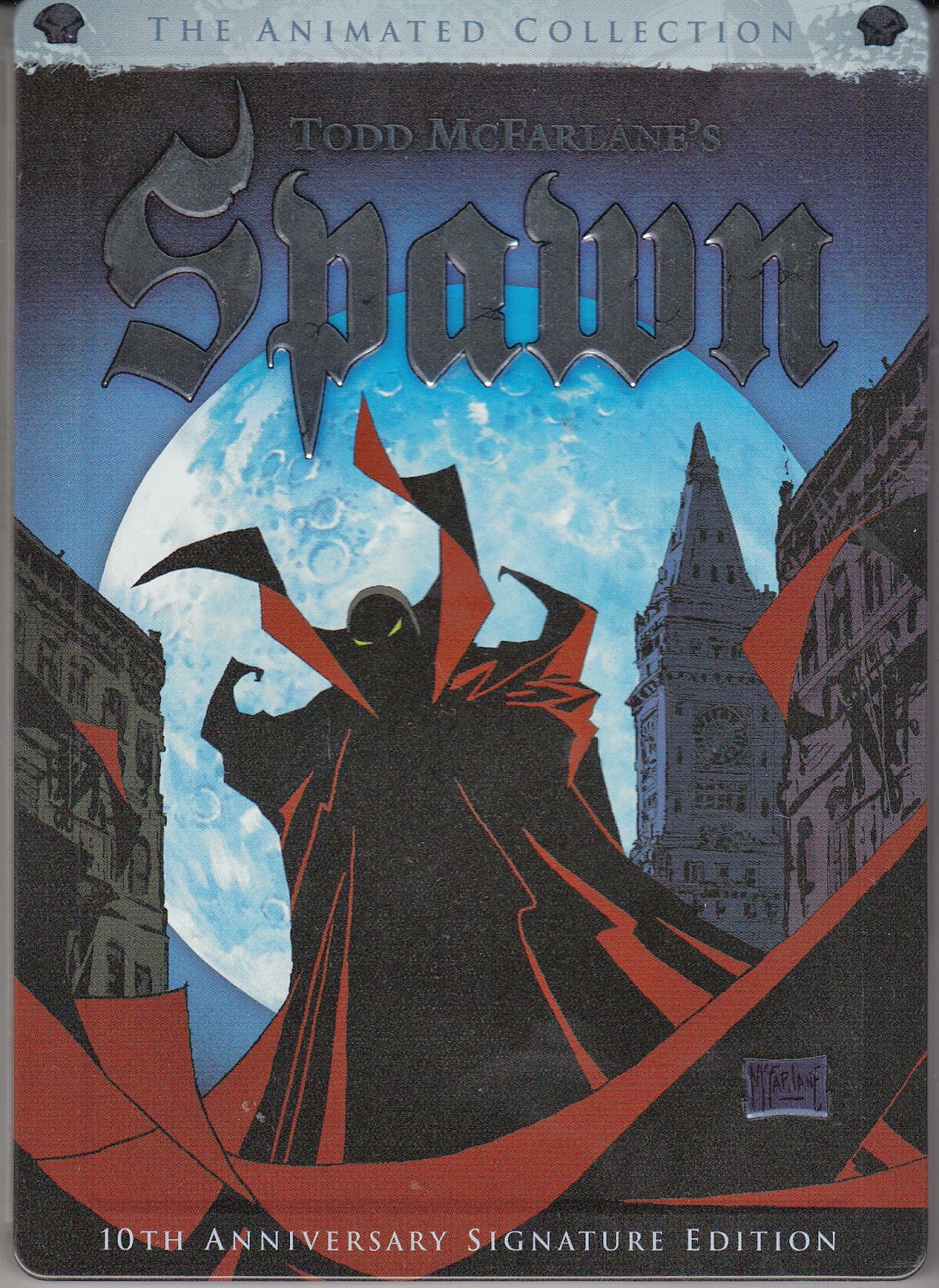
Spawn: The Animated Series (1997-1999)

The animated Spawn series ran for three seasons on HBO, if you can believe it. I had vague recollections of it being a little buzzy when it first premiered. It must have garnered some interest, since it was picked up for two more seasons. But as for the episodes themselves? I couldn't remember.....anything, really.

Upon watching them again in 2013, I know why. The scientific explanation for my failure to latch onto any solid memories of this show is because it is "not good". Oh, the production quality is there, even down to the DVD packaging. The case is solid metal, you'll break your foot if you drop that case on it. The animation itself looks fantastic, albeit DARK. This was the late 1990s, when cel animation was still the norm, thankfully. Anything digital causes my brain to simply check out and leave me cold. I think the only digitally animated show I can watch and enjoy is the short-lived MTV Spider-Man series. But I'm getting off track.

So yes, the show looks good, and the show sounds good. They got Keith David to do Spawn, (you may remember him voicing Goliath on Gargoyles) and Michael McShane does a wonderful rendition of Twitch. There's nothing unprofessional about it.

I was surprised at just how spiritually dark the show is, even given the fact that HBO was unlikely to restrict them much. Al Simmons is depressing to look at, and depressing to listen to. He mostly sits by himself and moans things like "Who am I?" for no particular reason.

For sport, he sits idle while maniacs and former acquaintances murder homeless people around him. He can see it happening, and he almost always exacts some kind of vengeance when it happens. But he can never be arsed to prevent any Bum Abuse. Sometimes he abuses them himself, verbally shredding innocent people who are inexplicably interested in being friendly with Simmons.

Spawn exhibits no sympathy or empathy for anybody apart himself, his wife, and his daughter. He exhibits no interest in doing much of anything to improve his plight. Mostly he whines, moans, and kills people if they don't leave him alone. He's not an interesting or likeable character, which is a problem.

Then there's Clown. Hoo boy. At one point he snatches a picture of Wanda away from Spawn, fires his hand down his pants, and then just starts tugging. That's the kind of show we're dealing with here. And that's almost interesting, if relentlessly maudlin.

Todd McFarlane is the blessing and the curse of Spawn. No corporate entity would take the chances that he does with that IP. Masturbatory clowns? Never going to be drawn from a corporate well, but Todd is free to do what he likes, and some of that feels almost novel and fresh.

In fact, if I were to point one shining element of the series, it would be McFarlane's intros. Before each episode, a camera creeps up behind a doodling McFarlane, at which point he turns around and presents some thematic questions before advocating that you turn the lights off. There are usually skulls and potions about. It's all very spooky.

He comes off as a bit douchey and too serious about the whole thing..but you know what? He's also captivating. You learn more pertinent information about the Spawn mythology in those fleeting moments than any ten episodes of story content. He clearly has a clue about what he wants to do and what's driving his story, and he's genuinely passionate about it.

Here's the problem - somewhere along the way, Todd McFarlane got it in his head that reminding an audience they don't know things about the story is a story. And it's not. That's the opposite of a story. He still hasn't figured that out, by the way.

I guess we'll never know for sure, but if I may engage in a little story forensics, I blame the Hobgoblin frenzy of the mid-to-late 1980s. You remember the Hobgoblin craze in Amazing Spider-Man, right? I know Remy does! The Green Goblin was dead and gone, Peter had all the Osborns accounted for, so who in the world was this jacked-up asshole in the goblin glider throwing exploding pumpkins at Spider-Man? Nobody knew. For a LONG time. Spider-editor Jim Owsley (now Christopher Priest) kept the secret so well he wouldn't tell Jim Shooter. Sales rose, people were talking, and it was all over the mystery of the Hobgoblin.

Well, McFarlane comes onto ASM not long after that. He had been doing work for awhile, sure, but it definitely had to be in his brain. If you want to draw an audience, you dangle a mystery in front of them. That's what people want. That's what sells!

Unfortunately, what Todd forgot was that the Hobgoblin mystery was built on a foundation of hundreds of issues of meaty goodness, not obscure ghosts. The mystery worked because the psychological base was so juicy.

Quick impression of Gwen Stacy's spine for you:

"Snap!"

Ta-daaaa!

That's why Peter Parker and his audience cared about the Hobgoblin. There was a tangible, gripping history there. Spawn has none of that. Who is Al Simmons? I don't care. He's a mopey jerk. And a government hit man before that. Yuck.

And if I don't care about the main character, how many tons of apathy do I have toward the diabolical Jason Wynn, his missing gun shipments, and his plans for the White House? Those threads comprise about 40% of the plot, and they generate zero interest particles. I couldn't explain to you why those elements are in there.

I suppose those conspiracies connect to the main story because they put Wanda and her new beau Terry in jeopardy. But we have no idea who these people are, because Al doesn't really remember them, so who cares? Or maybe it's a cautionary lesson about government corruption?

It's hard to know what the lessons of Spawn are. I feel like somewhere deep below its nougat filling, Spawn wants you to know that there is no fate, and that you can always choose a redemptive path for yourself. You can almost sense that somewhere around chapter 2,354 Todd wants Al to find a way to break his pact with Malebolgia, disrupt the plans of hell, and then wait in heaven for Wanda and Cyan to return to him.

If that's the case, Spawn is taking a really bizarre path in getting there. Occasionally this cat named Cogliostro shows up and irritates the shit out of you. By the way, the only way you'd know the guy's name is Cogliostro is by reading the end credits, because he certainly doesn't advertise that fact. It's a mystery, so that it makes it interesting, right? (slaps palm with forehead)

Cogliostro knows everything you as the reader/viewer need to know in order to understand and care about the Spawn story. He reminds Spawn (and you) of this each time he appears, and revels in keeping all of those treasures to himself. Here's an encapsulation of an actual conversation between Spawn and Cogliostro in a dark alley:

SPAWN: Piss off, old man! I'm busy brooding!

COG: You're about to make one of the most important decisions in your life and the future of earth, and you'd better make the right choice!

SPAWN: Uhhhhh! So annoying! What are you even talking about?

COG: If I told you, it wouldn't even matter.

At that point you just kind of throw your hands up and concede defeat. That's not a narrative, it's a skeleton of a narrative so lacking in manners that it outright tells you that it will never have any meat on its bones.

Precious little of the skeleton makes sense, by the way. As the Spawn story is constructed, the Hellspawns sign a pact with Malebolgia. Apparently something about this process invariably produces amnesia, at which point Malebolgia sends them to earth so they can bitch about how non-compliant the Spawns are. What??? He doesn't remember making "the deal", why would you be surprised that he's not living up to it? And the only information you as the audience would know about "the deal" is from Todd's intro, not the story itself. All the "story" does is remind you that you don't know what happened, and neither does he. It's madness.

If you show Simmons make the deal to be the Devil's muscle in exchange for being re-united with his wife, and then watch him pop up five years later when she's already moved on, NOW you might give a crap about things. Particularly if you establish a real loving couple first. And it would help the audience invest in the character if they know more than Spawn, but are unable to help as they watch him get pummeled by forces out of his control. They might even identify with such a character.

But not this character and not this series, unfortunately. It's a lot of darkness, and child molestation, and shooting, and altogether too much interest in government insiders and conspiracies you couldn't possibly care about. But it's definitely Spawn. Is it worth watching? Ehhhh....no? I recommend viewing the Todd intros and skipping the rest.

Monday, October 14, 2013

Bloated Halloween part 3 - Afterlife With Archie!

Afterlife With Archie # 1
Script: Roberto Aguirre-Sacasa
Art: Francesco Francavilla

Just a quick heads up...I'm going to spoil the crap out of everything, so if that's a problem, stop reading this and then sprint to your nearest LCS to grab a copy of this book.

It is the greatest of all understatements to say that I had high expectations for this comic. A good story can be crushed by those kind of lofty demands. Perhaps my review is complete when I tell you that the first issue of Afterlife With Archie satisfied all of my unfair preconceptions about what it could and should be, and exceeded most of them.

This is a really, really, really good comic book, and a nearly perfect horror comic.

I talked about this comic for a bit on the latest installment of Chronic Insomnia, and I placed most of the credit for AWA's success with Francesco Francavilla. My thinking has crystallized a bit more in the few days I've had to sit and ponder.....and while I still believe that Francavilla's efforts are the lynchpin, I shorted Aguirre-Sacasa just a little, and I mean to rectify that here.

The primary obstacle to Afterlife With Archie is the fact that every fiber of Riverdale's being strains against darkness and horror. Neither the characters, nor the tone, nor the history of the concept want anything to do with Somber Town or Disturbing City.

So....how do you do it? How do you build a fort of dread out of cheesy smiles? How do you get a modern audience to invest in your world when there's a guy with a crown on his head in the scene? A yeomen stands no chance of crafting a structure that will stand up to the audience's disbelief, and a master craftsmen would look at the materials, furrow their stately brow and pass, wouldn't they?

But if you had to do it with those tools - what's your plan?

Well, here's what Roberto Aguirre-Sacasa did: Firstly, he made the incredibly brave/bizarre decision to play it straight, and hew closely to the zombie classics. It's hard to overstate the balls it takes to attempt something like that. If you were worried about the book treating the material seriously - put those worries to bed.

This is a pure horror book. It's dark, it's apocalyptic, there are moments of Kafka/Cronenberg level body horror. The comic begins building dread with the first page and never lets you off the hook for a moment. There is no ironic winking to the audience, self-deprecation, or "aw shucks" smarminess to rescue you from the sense that things are going terribly, terribly wrong and you're not sure you want to see how wrong but goddamnit you have to turn the page to watch it happen any way. If you like George Romero, you'll love this comic.

So what tools does Aguirre-Sacasa have to use? Well, trouble in Riverdale often begins with its resident jerk and bad seed, Reggie. In this case, the end of the world begins with Reggie's ill-advised decision to drive home after a few too many drinks.

His impaired driving takes him on a collision course with Jughead's lovable pooch, Hot Dog. And he dies.

Uh-oh.

In order to get zombies, you're basically stuck with two options - science or magic. Well, the Archie house has licensed Sabrina the Teenage Witch. So Jughead takes Hot Dog over to Melissa Joan Hart's house to see if there's anything to be done. It makes sense. Not logically, of course. You've seen Pet Cemetary, you know how this works. But grieving hearts don't engage in high-level thinking, they only know the hurt of loss.

The witches examine Hot Dog and declare him a lost cause. Had he still been breathing, they could have coaxed more life into him. But once a creature has passed into death...only necromancy brings them back, and that is strictly verboten. For good reason.

Sabrina is a good friend, though, and can't bear to see her friend in such pain, and do you see where this is going? Of course you do, because you've seen this story before. If you want to assign five demerits to Sacasa for borrowing too much and innovating too little, I will understand. I forgive it in this case because it makes so much sense, both in terms of plot and character. I believe these people might do these things in those situations.

Sabrina grabs her Necronomicon and tells Jughead to grab a shovel. They bury Hot Dog, Sabrina chants the incantations....and then comes another wave of building suspense. The comic is constantly reminding you that you have X hours before the end of the world begins. Hot Dog comes back, but he isn't quite right. He bites Jughead. Then Jughead isn't quite right.

When you think about it, it absolutely had to be Jughead. Who else but the character defined by his depraved, gluttonous eating? This is what I'm talking about when I say that I underestimated Aguirre-Sacasa's input. Part of the reason why the book is so air-tight is because he found a way to take those seemingly impossible ingredients and create a savory dish without cheating. That's the character: grotesque eating! Sacasa found a real zombie story in the available materials, without changing or denying any of them.

Once the stage is set, he ratchets up the tension. Sabrina's infraction is instantly discovered. This isn't Fantasia, where the apprentice gets swatted on the behind with a broom for his hijinx. Sabrina's elders remove her offending mouth and then park her into another dimension for a year to cool out for a bit! That might be the moment where I completely submitted and said "Holy shit, this is for real!"

It's all for real, and it all feels "real" because Francesco Francavilla makes you believe it with his incredible art. I'm not sure what else to say about it other than to declare the obvious - looking at these pages is like walking into a classic horror film.

The angles, the lighting, the coloring...I don't know what it is. I don't have those goods in my analytical tool box. The lines aren't strictly evocative of anything I can point to. It doesn't photocopy Night of the Living Dead or Dawn of the Dead. It doesn't precisely look like those things, but it indisputably makes me feel like I felt while watching those things.

Aguirre-Sacasa brings a kind of poetic sense to the story, but it's Francavilla who sells the authenticity of the horror. This is Eisner-worthy stuff. No, I'm not even close to kidding about that.

Bottom line here is that if you have any interest in horror at all, this is a MUST buy. If you have no interest in horror, this comic is so good it might just swing you over and is a MUST buy. It's $2.99, people, you can feel good experimenting and rewarding the effort.

It even feels like a real comic when you hold it in your hand, because the cover stock is thicker than most anything published these days and has a little "grit" to it. Kudos to the folks at Archie for going all out and paying attention to even the production value.

It's even interesting in a Market Spotlight kind of way. AWA is a direct-market only book, they don't want kids at the grocery stores grabbing this off the shelves and scarring their souls for life. So these might be the scarcest Archie comics in well, ever.

In the back matter, Roberto Aguirre-Sacasa tells the origin story of the comic, and cites the zombie variant to Life With Archie # 23 as the inspiration. That makes it an instant classic, and if you should find one at your LCS, I would grab that with gusto. And then sell it to me. I desperately want one of those!

What this reminds me of, oddly enough, is a speech that Alfred gives to Bruce in Batman # 24. (side note: Batman # 24 is a piece de resistance, tour de force, instant classic, and slap any other superlatives you care to on it because it deserves them all) He tells Bruce that he needn't worry about his identity being discovered because deep down, people want to believe that something eternal like The Batman can exist. Now, if you're a fraud, people will reject that and delight in tearing you down. But if you have the skill to sell it, people will delight in submitting to the show.

Francesco Francavilla will have you a believer. Go get this comic.

Tuesday, October 8, 2013

The Ugly American's Comfortably Bloated Halloween, part 2: More Werewolves!

Werewolf By Night # 14
Script: Marv Wolfman (no, I'm not kidding..that's his name)
Art: Mike Ploog/Frank Chiarmonte

Last week the Ugly American tackled some modern mob-type werewolves, and they were pretty darned good. If you want to travel to the center of my heart, though, it resides in a magical land called the Bronze Age.

I think a lot of people forget - there was a significant chunk of time when you couldn't publish profitable comics without the Comics Code seal of approval, and they had pretty much outlawed all horror elements from the medium. So in the 1970s, monster books were a delicious forbidden pleasure, and Marvel eased back into the genre with a pile of creature books like Tomb of Dracula, Frankenstein, Man-Thing, Zombie Tales, and of course Werewolf By Night.

The Marvel monster books were tame in comparison to the pre-code EC material that drove the genre underground, but still great fun. In the case of Werewolf By Night, the protagonist Jack Russell uses the wolf as an unwitting tool against evil. That's how you got around the code, of course - you kept the blood to a minimum, and you made sure the bad guys were getting the worst of it.

While the code did limit some of the overt sex and violence, Werewolf by Night brought healthy dollops of both in a very attractive package. My favorite cover in the series is # 14, with a classic Mike Ploog werewolf facing off against the diabolical mage Taboo and his lovely assistant Topaz caught in the middle. Delicious!

How do I adore Mike Ploog's art?...let me count the ways. First of all, his wolf creature is BAD ASS, ready to rip, and a powerfully lithe figure. A lot of guys want to communicate power through size, (and that can work, of course) but what a great choice Ploog makes to eschew that in favor of a more natural figure. Look at the way he's posed the Wolf, especially with the right arm in a posture that human beings just don't take. Green pants aside, that's a beast you do NOT want to mess with, and you don't need the monster bulked out to convey it.

Ploog is communicating everything you need to know about the character through the eyes. The Wolf and Taboo have the narrow menacing eyes, and Taboo's overly-developed arched brows take him over the top. Topaz has the overly-large manga style eyes, partly because that character's heart is about to pound out of her chest, and partly because it's an old trick to establish a warm openness to the character.

A couple other items strike me about the art in general, and that cover in particular. LOVE the Kirby Crackle floating out of that cauldron in the back, classic 1970s! I like the accentuated chubby fingers on Taboo, as well. I guess I wouldn't describe Ploog's style as "cartoony", but some of the features are a little exaggerated (in the best ways) and it tends to soften things a bit.

Again, the publishers have the code to deal with. You don't necessarily want your art team to take a "John Buscema on Savage Sword of Conan" approach. It would be gorgeous, but it would feel too real...not safe enough. In my opinion Mike Ploog's pencils are perfect because he's revelling in the horror elements without skeeving you out in a Crossed sort of way. That's not a knock on Crossed, mind you, there's absolutely a place for that book. A 1974 spinner rack at a 7-11 is not one of those places, though.

The story is easy to grasp and recapped nicely on page one. The basics are these - Jack Russell is cursed to become a Werewolf By Night, and he's currently in possession of a book of dark sorcery called The Darkhold. Taboo wants it for nefarious purposes, Jack doesn't want him to have it. Jack is kind of swaying his assistant Topaz over to the side of angels, and Taboo has somehow transported the mind of Jack's hated stepfather into a monstrous golem.

Let the battle begin...ding! ding! To up the ante, sunrise hits the venue in the middle of round five, and now Jack has to battle Algon without the benefit of The Wolf to help.

That's the tip of the iceberg...there's a ton of story in this issue. I won't be handing out any spoilers here, but I can tell you that tension abounds in this issue. Neither Jack nor the Wolf like Taboo very much. Topaz is torn between the devil she knows and a possible life with Jack she may not fit into. Jack likes Topaz, but how in the world could he ever trust her? Jack is always at odds with the Wolf. (although sometimes he slips up and says "I" in the voice overs when the Wolf is acting) He can't stand his stepfather, because he killed his birth mother. But he can't just let the guy get stuck inside a monster, either, can he?

The key to the old (and also the new) Marvel books is that relentless wave of dramatic tension. Things rarely work out perfectly for these characters, there are always urgent and generally relatable problems to be solved. I feel like I'm out of control sometimes. I think the girl I like is really terrible for me and has daddy issues. My stepfather's mind is trapped in a magical killing machine. Nobody is building to an "event" here, where everything we know about Jack "changes forever". It's a story about a guy with interesting problems, and he tries to solve them.

And by the end of the issue, some of those problems have clean resolutions. Some of the problems have become more complicated. Then we're on to the next thing, which in this case is a trip to Transylvania to square off against Dracula himself. Stuff is moving, baby! That's Bronze age Marvel comics at work.

But wait...there's more. You'd be getting your 20 cents worth just with the Marv Wolfman story and Mike Ploog art. But what if I told you that the Record Club of America was offering 6 LPs or 5 cassette tapes for only 99 cents, with no further obligation to purchase anything else? The correct answer is: JACKPOT!!!

They weren't offering any musical dregs, either, my friend. We're talking about epic material like Helen Reddy, Donny Osmond, and Three Dog Night. Now those are treasures.

You don't see too much of that in today's comics. Mostly because nobody makes cassette tapes any more. You get a lot of house ads in today's comics, and you get some video game ads. I like the old books better with horrifyingly stupid Hostess comics, and Sea Monkeys, (never had the balls to order them) or 7,312 green plastic army men for $2.00 is always good as well. I definitely ordered several billion of the green plastic army men. Were they more likely to get caught in the blades of the lawnmower, or my trachea? Pretty much a coin flip. Why was I sucking on military men with telescopic rifles, any way? Best not to ponder that, I think.

Let's change the subject and check out this Mike Ploog splash page, huh? Look how he's got the story elements of the panel lined up perfectly in that classic "Z" pattern that your eye (unless you've been reading manga your whole life) naturally wants to follow. You almost don't need the captions to figure out what's going on.

Taboo has called on the spectral avatar of his assistant Topaz and shot her mystically into Algon, who already has a disturbed mind inside. Ploog went trippy with the psychological battle; I think Algon's pained expression in the bottom left corner is just priceless. I think that's the kind of panel that the old Marvel Method invited an artist experiment with.

A full script writer might attempt something similar, but I think they're going to get it wrong more often than not. Both styles have advantages, but the older I get the more I see the value in the give-take-give approach. The writer designs a solid blueprint, the artist constructs it with real trench know-how, and then the writer takes that solid structure, sees how beautiful the construction team makes it, and then adds a little koi pond or tasteful rug to really bring the room together at the end. Sometimes when the blueprint guy tries to do the drywall...the whole thing comes down. Or looks ugly.

I love pretty much everything about these Bronze age gems, if you can't tell already. I like the letters page and Stan's soapbox. And hey, you didn't think Stan would let a page go by without a little cross-promoting of other Marvel titles, did you? Well, he doesn't. My favorite in this issue is a Conan advert letting you know about an upcoming tussle with "Thusla" Doom. And if you think he's bad news, you should see his cousin Thulsa. That guy was so formidable they had to get the voice of Darth Vader to play him.

Anywho. Halloween is a good excuse to revisit these treasures. If you're not occasionally going back and diving into some older comics, you're doing yourself a disservice.


COMING UP NEXT:

Nothing in this life could possibly prepare you for how awesome Afterlife With Archie is going to be. The first issue hits stands this Wednesday, October 9th!!!! No mortal is worthy to review such a macabre masterpiece....but lucky for you The Ugly American is prepared to venture where angels fear to tread. I'll be back with a full review soon!