Monday, September 23, 2013

Ugly American - Forever Evil # 1 Review!

I bought Forever Evil # 1, and I'm not sure why I would do that to myself. I don't like Event Books generally. I've spilled gallons of ink crusading against the publishing and purchasing of $3.99 comics from the Big 2, and this is certainly one of those. I don't like hypocrisy, and buying Forever Evil after all that crusading sure sounds like hypocrisy to me.

So why the hell did I do it? {briefly rationalizes before beginning tap-dance} It's true that I tend not to like Event comics, and I still believe that buying $4 comics sends a bad signal to the publishers. On the other hand, I have always been an advocate for buying whatever the hell you want, so long as you understand the consequences. I do. My signal is mixed, I guess. I'm telling Marvel and DC:

"I'll test drive one of your monstrous debacles of spectacle every few years just to see what's going on."

It's probably important to do that every now and again just to maintain some objective integrity. If all I ever do is rant about these Events and never read one of the damn things, I'm ranting from a position of ignorance. Which wouldn't be unprecedented, but is not ideal. So here we go!

Forever Evil # 1 (DC Comics)
Script: Geoff Johns
Art: David Finch/Richard Friend

Boiled down to its essence, Forever Evil is the story of what happens when an evil Justice League from another dimension removes the real Justice League from the playing field, and it becomes the duty of Earth's villains to rise up and Take Care of Business.

This is actually not a bad hook, as hooks go. It's a very big story, and it offers ample opportunities for undeveloped ciphers to blossom into full-fledged complex people. So I like all that.

That platform contains a few inherent problems, however, and all of them manifest in this comic book. Big is good, and big is grand, but it's difficult to accomplish big in a few pages. Here's what happened from a plot perspective in this comic:

-Lex Luthor is a bad person, and discovers that someone has taken over global communications
-Nightwing gets captured while delivering Mr. Zsasz to Arkham Asylum
-Rogues receive a secret decoder coin inviting them to the Big Meeting At The Docks
-The Crime Syndicate announces that they have murdered the Justice League and will now be taking over planet Earth at the Big Meeting At The Docks
-Nightwing has a really bad day
-Ultraman pushes the goddamn moon in front of the sun because it's irritating him

Some significant things happen, sure. Most of them don't happen on the page, which is a bit striking. That bit about the dead Justice League? There isn't a sniff of that actually on the page in Forever Evil # 1. We're taking the Syndicate's word for all of it. The reader never really gets to see how any of this global takeover transpires. It's just baked into the plot via expository dialogue, which frankly feels weak and greatly reduces the drama.

This is not unique to Forever Evil, either. Bendis just did this with the Ultron thingy Marvel trotted out.

"Ultron has completely taken over everything!", says Bendis.

"Sounds cool", you say while recognizing that you're sort of bullshitting yourself about that, "how does it happen?"

"Well..." says Bendis, fumbling to come up with something but then realizing that he is indeed Brian Michael Bendis and therefore can do whatever he damn well pleases without editorial permission or peasant scrutiny "....he just did! See how all the buildings are knocked over? It totally happened! Now on with the rest of the show!"

It is possible to tell a good story that begins en media res, of course. You can get to the mysterious origins of the conflict later on out of sequence. This kind of fancy footwork is rarely worth the cost, in my opinion. You can even completely ignore the hows and whys of your giant conflicts, if you like. George RR Martin rarely shows the reader giant battles or military actions "on screen" in the Game of Thrones series. You usually get that sort of information second hand and days after via conversation between characters who weren't even primary witnesses.

It works in those books because of the intricate character work, and because it feels authentic to receive that kind of news in the same manner as the characters - second hand, out of date, and colored heavily by the messenger. It works because Martin understands that what counts are the people, and the succulent little details.

Most of the character work and details feel just a bit "off" in Forever Evil. Here's what I mean by that - take this early scene featuring Nightwing, in which he delivers a trussed up Mr. Zsasz to Arkham Asylum. Finch puts together a very nice action pose that would look fantastic framed on your wall.

Unfortunately, it just doesn't make a lick of sense. Listen, Dick Grayson does a lot of push-ups, so I can almost believe he could carry a grown man around like that for awhile. But not even the Hulk could swing around a city with a guy cradled in one of his arms, because it just takes two arms to do that. The entire premise is absurd.

This guy learned from the world's greatest detective, right? He should be pretty smart. How does he not know that it would be far easier and more efficient to just rent a Jeep Grand Cherokee and then ask Mr Zsasz if he smells chloroform on your rag?

Listen, I know it's comics. There must come some suspension of disbelief so you can roll with these things....but think about it - how much better would it be to read about a Nightwing/Zsasz road trip? Now there's a comic I would absolutely buy! It's like Midnight Run, and the two of them can learn some stuff about each other, and get into hijinx together, and now they have a relationship that you can build on the next time Zsasz does inevitably escape from Arkham.

But that's not the point of these events, and there's no time for anything really interesting to happen. Only two characters get explored in even trace amounts of depth in this issue - Ultraman and Lex Luthor, who shares a delightful little story about a cat that sheds some light on his motivations as a human being.

But this Nightwing thing? It's random, and it spits in the face of logic, and it draws attention to the hands of the puppeteers. Dick just happens to be there at the same time as Evil Wonder Woman, because the comic needs Something Dramatic To Happen To A Suitably Popular Character.

The problem, of course, is that the randomness of it all means there isn't any drama in the "dramatic" stuff that happens to Dick Grayson. Spoiler time - what happens is that the Crime Syndicate beats the crap out of Nightwing, unmasks him, and then tweets his secret identity to the world at large. It's unpleasant, sure, but there's nothing in the character or in the story (to my knowledge) that makes any of that mean anything.

Here's a really bad example of something that might work:

Let's say Nightwing ended up crossing paths with a troubled little girl while fighting crime in Bludhaven, or Chicago, or wherever the hell he's headquartered now. Maybe she's got no father and he put her mother in prison, and he feels responsible. Maybe he goes through an arduous adoption process, and he agonizes over the decision because he worries about how much his second life might be putting the child in danger. But maybe he goes through that process, and the little girl is starting to buy into that process and starts accepting love and turning her life around.

If you set all that stuff up, then when Dick Grayson's identity is exposed, you actually feel it in your gut. It's something born out of character and story, and if you actually care about that little girl and her relationship with Dick, (man I wish I hadn't typed that) Forever Evil put that girl in dire jeopardy and it becomes something you might really anticipate on the rack each month. You might even remember that story six months down the road.

Why would the Crime Syndicate even bother with a single secret identity, by the way? To prove their reach or resolve? Why not publish the whole NOC list? But really, I would think bodies would communicate better. Producing Justice League corpses would achieve that end far more effectively than a B-Lister's name and address. Show me Superman's head and my balls will retreat into their natural orifice. How does outing Nightwing accomplish anything for the Syndicate? Inside the story, it really doesn't. Outside the fourth wall, that "news" will tend to make the regular comics sites, though, and that's what it's really about.

That's all I can see when I look at Forever Evil....puppet strings and puppeteer hands. I see DC trying to establish September as the Month That Big Doings Happen, so this book has to exist whether it needs to or not. I see a lot of villains gathered together in a room, hell, it took a four page splash just to fit them all in! It's a nice picture, it really is, I'm not just spinning bullshit about that.

But what does it mean? It means that random characters will utter stilted nonsense. Who is Cheetah, anyway? As a person, I mean. Would she ever really say "Nor I, Grodd, but give them a chance to speak." I guess I don't know if she would actually say that or not. But it sounds....wrong. Like a bad puppeteer got hold of her and started moving her mouth for her.

I know Black Manta doesn't like Aquaman, that's pretty standard. The Crime Syndicate just tosses out Aquaman's trident and Black Manta claims it like something important just hapened. How anti-climactic is that? Manta did nothing to achieve it, for all anybody really knows, it's not even real. That would be like criminals burning down the Baseball Hall of Fame, and then tossing Ernie Banks a World Series ring. He'd probably throw it back in the criminals faces...there's no catharsis in that, no achievement.

In an actual story with actual human elements, Black Manta would likely resent whatever asshole took Aquaman down and spit on that trident, because it cheats him of his victory. He doesn't pick it up and do a touchdown dance. That's the opposite of a character moment, but it feels like it has the requisite weight to be "big", so there's your event book. It's 5,000 calories, but it actually tastes like crap and has absolutely no nutritional value.

Do I even comment on the absurdity of moving the moon in front of the sun? If you like logic or physics or yourself, you don't like that. But it's "big", I'll give it that.

To be honest, I don't hate Forever Evil. It almost salvages the Villains Month debacle for me. I still don't think it was worth the allocations and the retailer headaches, or completely derailing the narrative flow of the entire DC universe. Forever Evil establishes that the heroes are gone, and the villains must step up to protect our world. Villains Month is a way of saying "let's learn a little something about these unlikely caretakers, shall we?" The execution on most of those comics ranged from adequate to deplorable. But given the Forever Evil context, it nearly makes sense now that they did it.

So no, I don't hate Forever Evil. It does exactly what it sets out to do - declare that it is important in the most ostentatious and unconvincing manner possible. Whenever somebody feels compelled to announce to me how important they are, I know to quickly file that business card in the trash.

Mostly I just feel sorry for Forever Evil. It very much wishes it were a Valiant event, built on the natural confluence of rising story actions. But it's not. The calendar turned September, so everybody got together in one panel for a group photo, Nightwing got his ass kicked, and The Monocle got his head blown off and took one for the team. For the depressing, soulless team. Sad.

I'm done with Forever Evil, because it's not really a story. I would like to read a story, please. Maybe when I check back a few years from now, an Event might actually provide one. Hope springs eternal!

Tuesday, September 10, 2013

The Ugly American On Batwoman

So, I've been purposefully trying to avoid Bunny Talk... but I have to get back to it this week.  It's a little depressing, but it's also important.  Sometimes you have to do the Good Work even though it may not feel like fun.

What set me off this time were violent threats sent to certain folks at DC over JH Williams unscheduled departure from Batwoman.  Williams recounts the usual sins when these things happen, and they happen a lot lately.  Stories are broken, creative work gets approved, and then at 11:59pm editorial sends a note saying "change everything, and get that to us by midnight".

The wrinkle here is that Williams specifically pointed to DC vetoing a proposed marriage between Kate Kane and Maggie Sawyer as a sticking point.

Uh oh.  That'll get the Bunnies attention, won't it?

So now we've got death threats coming into DC if JH Williams is a credible source, and I don't see why he'd lie about that.  Not to belabor the obvious, but this is not (just) about a creator leaving a book before the fan base is ready.  This is about an "attack" on gay marriage, and a small but unduly influential group responding as they always do when somebody has the audacity to disagree with them.  The Bunny credo is - think like I do or be silent, be gone, and now…. be dead, I guess.

I've been banging this drum for a while....but are folks finally getting the idea that the Soft & Fuzzy Bunnies are not the tolerant, benevolent creatures sold in the brochure?

It does not surprise me a lick that DC is hesitant to let JH Williams run with his gay marriage storyline.  It's storytelling 101, and DC is (supposedly) in the business of storytelling and not gay politics.  DC has no gay agenda, and no anti-gay agenda. DC has a money-making agenda, and marriage (gay or otherwise) has never been a big breadwinner.

Do people not remember the lengths that Joe Q went through to nix Peter Parker's marriage? When DC went to the reboolaunch, they instantly split up Lois and Clark.  Personally, I think the marriage dampening effect is overrated, and a good writer could very easily concoct some marriage-based stories that would heighten drama, not diffuse it. But the truth of the matter is that people are far more interested in "will they or won't they?" then "happily ever after."  And in the storytelling game, interest is a pretty precious commodity.

Moonlighting figured this out the hard way.
 Things tanked pretty hard when Dave and Maddie finally hooked up, and that wasn't even a marriage thing.  That was just a boyfriend/girlfriend thing.   Of course nobody remembers Moonlighting, so that’s probably a bad example. How about this one? People want to watch Rick Castle and Kate Beckett dance the Dance of Longing, not pick out curtains.  You can build an entire show around sexual tension, and sink the whole ship by finally pairing people up.

But things are even more dire for Batwoman, because they can't even get the initial tension thing right.  Do you have any idea how hard it is to make two chicks making out boring? Williams and Co. have done it. They should probably invent a new Eisner award just for pulling that off.  Batwoman's crime isn't that it wants to portray gay marriage; its crime is that it is deadly dull.  So when Williams is proposing to make the comic even more mind-bendingly dull, DC can and should send the book in another direction.

When all this hit, the JH Williams blog indicated they’d be staying on until issue 26 and then packing their bags. DC saw the excrement hitting the fan and put Mark Andreyko starting with # 25, and you know what? Good for DC! I’m not in love with the editorial micro-managing that appears to be the norm over there, but if somebody is going to shit all over you, they don’t get to pick when they leave. An advisory not to let the door hit your ass on the way out is an appropriate response in those cases.

Everything comes back to bigotry and intolerance and bullying and oppression these days. Except this situation isn’t about being anti-gay, it's about being anti-boring.  Ask Orson Scott Card about DCs anti-gay agenda.

Incidentally, bigotry is still prevalent in comics, in significant doses.  It doesn't work in the manner that the Bunnies would have you believe, though.  Let me show you how comic book bigotry works in reality, on the page.

So let's take a look at how the police are portrayed in three recent comics: Daredevil # 29, The Movement # 1, and Robocop: Last Stand # 1.  It bears mentioning that in order to make this point, I didn't have to dig back thirty years to find three obscure examples of the phenomenon.  What I'm about to show you are very recent examples typical of the way comics depict police.

I'll start with Mark Waid's Daredevil story, in which papier mache redneck cops attempt to frame a black paramedic of a crime, and then attempt to murder him.

“No wonder they didn’t think they’d get caught”, says Daredevil. “Sounds like these racist fanatics have infiltrated the whole justice system. My justice system.”

I have to say, if I were Frederick Douglas, or Sojourner Truth
, or Jackie Robinson, or Martin Luther King, I would be super pissed right now. Because all of those sacrifices I made, and all of that progress I bled for, and all the benefits I worked pretty goddamn hard for…apparently none of it made a difference.

Could I please let everyone writing comics today in on a little secret? It’s not a very well-kept secret, but you’d never know it by reading the books – institutional racism is OVER. It’s over, and it’s been over for quite a while, and I know you like Mississippi Burning, and I do, too. Gene Hackman? The guy is fantastic. But it’s not 1955 anymore, and that’s mostly a good thing. So please do celebrate that!

Do individuals still exhibit racism? They surely do, and it’s not ideal, and we have lots and lots of safeguards to protect against that kind of thing because again… the Institutional Racism is over. Ask Paula Deen how institutional racism is going right now. The institution is now set up to gulag little old ladies with cooking shows if it turns out that they once whispered a mean racist word 20 years ago. That’s how institutional racism is doing these days. By the way, have you met the President? But I digress.

You know, art is supposed to be the lie that tells the truth. But I don’t find any truth in Daredevil’s extended assertion that our justice system is infested with racists, bent on destroying black paramedics. Instead, I find chilling evidence of quite the opposite when I read about Dave Forster and Marjon Rostami.

Did you hear about them? No, you probably didn’t. They’re a couple of reporters for the Virginian- Pilot, beaten by a mob of somewhere between 30-100. As the story goes, the pair were stopped at a red light when one of the mob threw a rock completely unprovoked and broke a window. When Forster inexplicably got out to verbally confront said rock-thrower, pandemonium and many head injuries ensued.

Their own newspaper failed to cover the story, and only one teenager was ever charged. Why wouldn’t the paper cover it, and why wouldn’t the police aggressively pursue the case? Because the assailants were black, and it’s bad form. The institution would rather people be beaten, even die, then appear racist. That’s the bizarre truth. I don’t know what’s going on in Daredevil’s world, because I don’t recognize it. That’s not art lying to tell the truth. That’s just lying, and I call bullshit.

Then you've got Gail Simone's Movement story, in which a pair of dirty cops confiscate some recreational drugs from some street youths. Their intention is to take it back to the car for “evidence”, because that's what cops do in 21st Century comics.  They don't stop crimes, they create them. They harass and bully people who have done nothing wrong, with no motive other than the intense pleasure they derive from doing so. You’ll notice the racist officers doing a lot grinning in these scenes, because they love it so much.

The crooked cops are considering letting the kids go, but not before Joe decides he needs to see one of the girls naked.  Who knows where things would lead from there?  We'll never find out, because the creepy degenerate Movement folks step in and prevent whatever crimes were about to occur.  Sexual assault of some type was on the menu for sure.

Speaking of cops committing sexual assault, how about the OCP merc police in Robocop: The Last Stand # 1?  These guys are even worse.  Not even any idle talk about letting these ladies go.  Nope, here the police just want to get straight to the raping.

Robocop kinda sorta gets a pass because it's a dystopian tale dedicated to the idea that there is only one good cop, and that's Murphy.  It's hard to tell the story of a world gone bad with only one good cop unless the other cops suck.  But it kinda doesn't get a pass, because it might be worse to build your story around reinforcing the stereotype.

I’ll give Gail some credit as well, because not all of her cops are strict caricatures. The Captain has a little more literary meat on his bones, and he suspends Joe and Luis. But I don’t think the Bunnies would forgive a movie featuring characters in black-face just because it also starred Sidney Poitier, so I’m not sure how much leeway is due there.

The “Bad Cop” stereotype exists everywhere in today's funny books.  The Ugly American has already recounted the tale in which he ejected from Green Lantern over the terrible, horrible people in law enforcement that had audacity to believe that Simon Baz might be a terrorist just because he happened to be a Muslim driving a stolen truck filled with explosives that accidentally blew up a whole building.

Bendis and Maleev's Scarlet comic is built from the foundation of dirty cops murdering her friend.  And hey, here's a new book:  Hit Police!  Well, now it's just "Hit", they took the police part off the title.  But make no mistake about it, those are definitely cops working outside the law to commit murders.  Because in comics, that's pretty much all the cops do. Sort of.

I guess there are four types of police officers currently depicted in comics:

• Cops that are racist
• Cops that like to rape
• Cops that commit murder
• Racist, rapey, murderous cops

Mostly, comics are populated with Cop # 4.  By the way, police corruption is a real thing, (entire history of New Orleans, I'm looking at you) and I'm not suggesting that writers can't talk about that.  What I'm telling you is that there are a wildly disproportionate number of despicable, evil, racist police officers.  These depictions are cartoony, largely inaccurate, ham-fisted, lazy, and destructive.

Listen, by day I work with police officers all the time.  They can be a difficult group to deal with, to be sure.  I see arrogance, and short fuses, and apathy, and all sorts of other human foibles that come with being human.  Mostly what I see are good people putting themselves in harm's way both physically and psychologically trying to protect ingrates that don't appreciate them and communities that don't support them.

Can you guess how many racist, rapey, murderous police I work with?  I don't think I've met one yet.  And I've met a lot.  Sometimes they don't come right out and announce that they're rapey murderers, so there might be some error variance to account for.  Let's say that as many as 4% of police officers might be racist and rapey and murderous.  You'll find bigger numbers than that at your PTA meeting, folks.  Comics are demonstrably and crushingly unfair to the police.

Except...hmmmm....is it all the police that are bad?  Because if we go back to The Movement # 1, there are two officers in that scene.  One of them wants a "peek" at a victim, and the other guy has a darker complexion and is named "Luis".  It's non-white Luis who actually suggests they let the kids go, and then evil white Joe suggests that not-as-evil-because-he’s-more-brown Luis should sack up and get on board with the sexual harassment part.

So is it cops that are bad, or is it white cops?  Hmmm.

If we go back to Daredevil, all of the white cops and the white judge are twisted and criminal.  The only officer in the whole book who isn't on the take is the Asian female cop.
 Huh. Interesting. If you're an Asian female cop, you're just trying to do your job, and you're hyper-observant, and you twig onto what's happening and valiantly try to stop the racist white cops.

So really, the message is that mostly cops are bad, but not all. A minority cop might be OK.  White people, though?  Evil.  Always evil.  Put a badge on them and all they can think about is forcing your sex from you. And executing you.

Incidentally, you'll never catch the Bunnies crying about any of that.  You won't find any lamentations over police depictions over at the Comics Beat.  I really doubt we'll get a "white people crunching" chart over at Bleeding Cool this month.  Why is that, do you suppose?

The answers are a little too involved to get into in this column entry, which is already overly long. There's enough material there for a book in those answers, honestly.  It's a complex cocktail of good intentions, vanity, willful ignorance, greed, and fear. Lots and lots of misplaced fear. Maybe I'll start attacking that next column, or maybe not.  It feels important to me, but I want us to enjoy ourselves as well.  I don't want to turn this column into an endless screed.

In the meantime, you'll notice that the “mean and insensitive Ugly American” is not only taking a pass on threatening Waid, Simone, or Grant with any violence...but I enjoy the work of all three.  I don’t believe these authors are doing anything for the greater good by stacking on to the Fallacy of the Omnipresent Dirty Cop/Evil White Guy, but I don’t see any malicious intent, either. I believe that each is probably a good person stuck in 1955 and simply running the playbook with the best of intentions. Of course, how would we pave the road to hell without those? My point is not to grind an axe or tell anybody to shut up.

My point is that we need to start publicly talking back to this stuff, because ultimately we get the world we deserve, and you don't solve bigotry with different bigotry. 

We need to get smarter fast, though, because running wild with New Bigotry is giving rabid Bunnies the idea that they have license to threaten people with violence, and with impunity.  It's getting scary out there, folks. Danger, Will Robinson!

Thursday, September 5, 2013

Ugly American: Hello, Goodbye!

Before I really get started, I just wanted to share something that’s been driving me bananas, even though I shouldn’t remotely care. It’s this Hundred Penny ad I saw in the back of some IDW book:


Do you see the problem here, people? It’s called the Hundred Penny Press because they’re charging you a dollar. So how in the hell is that “priceless stories for UNDER a buck?” In the immortal words of Inigo Montoya…”You keep on using that word…I don’t think it means what you think it means.”

Now, a well-adjusted human would simply look at that and be thankful that a publisher was gracious enough to offer product at a nice promotional rate. I, however, cannot seem to get past the part where the laws of mathematics are being treated like Marcellus Wallace in Zed’s basement. $1 is just never under a buck. Not even in comics. If you have any questions on the matter, just ask a six year old – they’ll straighten you right out.

The person who wrote that ad makes more than I do, by the way. Anywho. Enough of that.

All day today I’ve had the Beatles “Hello, Goodbye” running through my head, so I took it as a sign and built a column around it. You should always be assessing your pull list and cutting out the chaff so you can latch onto something else that’s more inspiring to read. This week I’ve decided to say goodbye to a title, and hello (again) to an unlikely new steady. Let’s start with goodbye, shall we?

Goodbye, Young Avengers!

Before you boo and hiss me, understand that I’m not suggesting that Young Avengers is a “bad” book. It’s not. In fact, it’s got an awful lot going for it.

For one, it’s a big ball of really pretty kinetic energy. Jamie McKelvie’s figures are just gorgeous. Everybody is impossibly beautiful, and things are moving along at a neck-snapping pace. Every issue has some kind of innovative panel layout, some new trick to pull out of the artistic sleeve. There’s a palpable sense of exuberance about Young Avengers.

Some of the characters are exceptional. Gillen’s Kid Loki is a modern marvel, although this isn’t strictly his book, and must share the spotlight with a lot of other shiny stars. Gillen’s even brought Leah back, after a fashion. Not sure exactly how I feel about that after losing her in JIM felt so punishing. There’s some joy there, yes, but it frankly cheapens how I feel about Journey a bit. And that’s sad. One thing it’s not, though, is boring.

Then there’s David Alleyne, aka Prodigy. I like smart characters, and now the twist is that he’s also bisexual because his power is to absorb just about anything outside of super-powers. It’s a clever consequence, and opens the door for a lot of other intriguing possibilities. If he can take on sexuality, why not psychosis? Isn’t hanging around Loki inevitably going to make him duplicitous? Hmmmm…lots of good stuff to be mined out of that character, and Keiron Gillen has the goods to extract it.

Why good-bye then, you ask? I’ve given Young Avengers nine issues to teach me what it is and what it does, and this is not a book for me. I’m an old man, and quite happy to be so. This is all emotion and urgency and hipness. I don’t necessarily need to identify with characters in order to find them interesting, but mostly I’m here on earth now to shout at these kids to get off my lawn. Reading these exploits feels exhausting, mostly.

I think if this comic had been published in 1991, it might be my most favoritest thing ever, because how could it not be? When you’re 19 years old, things are either the coolest thing you’ve ever seen, or soul-crushingly horrible. When you’re 41, you can look at a book like Young Avengers, entirely appreciate it for what it is, and then leave it alone without any hard feelings at all. So that’s what I’m doing. Good-bye, Young Avengers!

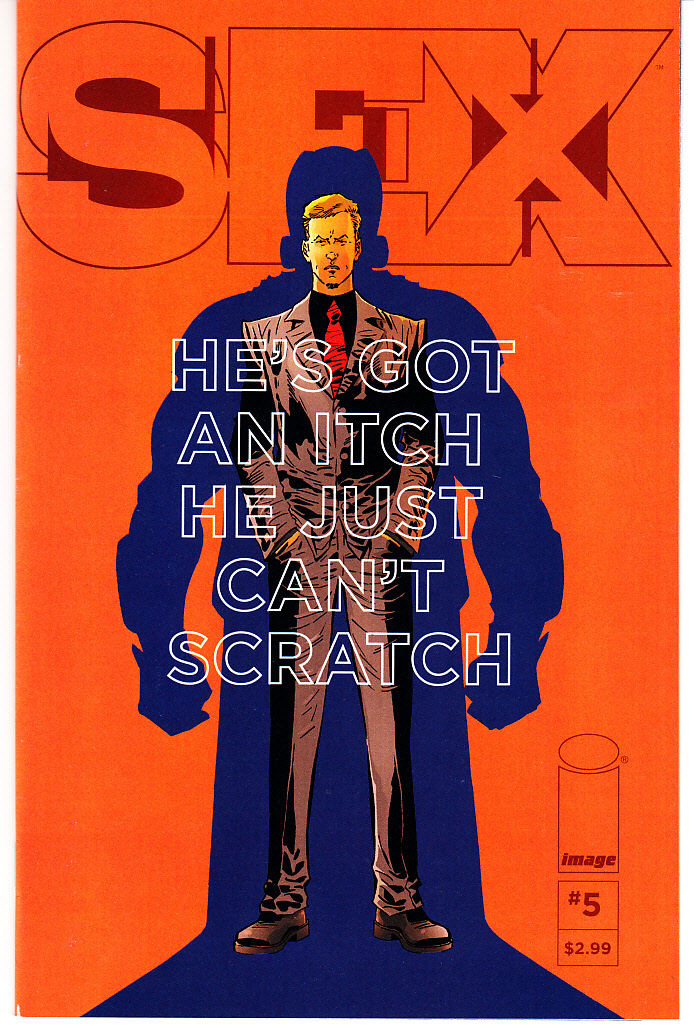
Helloooooooooo Sex!

Readers of this column will remember that the Ugly American gave mixed reviews to Sex # 1, which was delightfully perplexing. When issue # 2 hit the stands with that same collector’s item “joke” on the cover, I just couldn’t abide spending money on it. By the time issue # 3 came out, I had completely forgotten it, and even if I hadn’t I think Catalyst Comics had been released and Joe Casey’s “I’m a badass giving a finger to the man and making REAL comics” schtick was irritating the shit out of me and I wouldn’t have grabbed it out of spite.

And then when Sex # 4 arrived at my LCS, curiosity got the better of me and I picked it up again. My thing is, I desperately need to understand things. Sex was (and remains) difficult to put into a neat box. I looked at Sex # 4 and thought – “I might be a little lost here, but I’d really like to get a feel for what kind of butterfly this is turning into.”

To be honest, I think Joe Casey has similar feelings about the comic. I have zero indication that Casey has a concrete plan for how he wants to develop this series, which is equal parts intriguing and off-putting. I can promise you, you don’t know exactly where Sex is going. The reason I know that is because Joe Casey doesn’t know where it’s going.

There is a driving force propelling things, and it basically goes like this:

What if Batman got old, stopped obsessively feeding his Vengeance Demon, and tried to have a real life as Bruce Wayne? What if he dropped the cowl for good and actually tried to integrate into life by paying attention to WayneCorp and other human beings on a personal level?

That’s the hook for Sex – the personal consequences of a life spent avoiding real human connection. In Sex, the guy is Simon Cooke, and the alter ego was The Armored Saint. Simon is a middle aged man with absolutely zero social skills and personal agency. He’s spent the last 25 years of life looking at people as marks and assets. He doesn’t know what he wants, because he gave it all to The Mission.

So what Sex amounts to is a hyper-talented invalid failing miserably at life, in the most awkward manner possible. Here are the actual activities of Simon Cooke, broken down for the last three issues of Sex:

Chapter 4
• Silently watches old videos alone
• Tosses and turns in bed
• Dresses up like Fidel Castro then sits silently alone at a seedy bar
• Awkwardly talks about mid-life crisis feelings with his friend Warren, who looks like he should be played by that guy from East Bound & Down

Chapter 5
• Fails miserably at double dating with East Bound & Down
• Gets knob polished in bathroom any way
• EB&D carries him to bed where he passes out
• Takes a meeting with an empty suit the next morning

Chapter 6
• Passive aggressive awkward conversation with Mayor Sedgewick
• Stares silently over balcony, then has uncomfortable conversation with his assistant about her dating Sedgewick’s little lapdog

The Armored Saint is the ultimate inaction hero. You might be wondering where the sex in Sex is. There is some, but Simon Cooke isn’t getting any, at least not yet. Zero social skills for that kid. East Bound & Down is getting some, and the really puerile stuff generally happens when the wrinkled old villain of the book is on screen. There was quite a lot of ass rape in issue # 6, as I recall.

This book is more about the consequences of leading an unnatural life as a superhero. You don’t know how to talk to girls. You have no clue how to run your business, or relate to your co-workers. Annabelle Lagravenese ( the Catwoman analog ) is going blind because of the night-vision goggles she used to wear. The superhero life has consequences, and Sex is built like a documentary about them.

I’m almost ashamed to admit this…but I’m interested in that shit. I’m sort of rooting for Simon Cooke to grow into something more healthy as a human being. One gets the feeling that he might just end up transporting all that obsession he had for vengeance into sensory indulgences, and that would be bad. Might be fun to watch, though!

It also feels like Annabelle might be able to help him pull through. She has her stuff a little more together and could guide him through his transition, and he’d understand her on a level that other people just can’t, so that might work. Needless to say this is not how things generally work in The Avengers. It’s just a different kind of a book, and different is attractive to me.

They’re still doing that bizarre “lets color code certain key words in each word balloon” thing, which is really best left for dead. What would be the rationale for continuing with that other than artistic obstinacy? I guess the good news is that I’m mostly able to just tune that nonsense out at this point. It’s not a deal-breaker. On the plus side, you’re getting those fantastic Joe Casey commentaries on the back end.

People often wonder about the magic behind Walking Dead, but honestly Kirkman spelled it out in the beginning – what happens after the zombie movie? I think what people are responding to is that deeper plumbing of the Unhappily Ever After, that never really had been explored before. Sex is at least attempting to add similar depth to a tired old horse by asking – what happens after the superhero series? So far, it’s a lot of odd reclusive behavior and awkward conversations…but for some reason that seems to have me hooked.

Monday, August 26, 2013

Ugly American Retro Review: Amazing Adventures # 11

Script: Gerry Conway
Pencils: Tom Sutton

No idea why, but the Ugly American was recently curious about the particulars regarding Hank McCoy turning into the furry beast. The first time, I mean. I was pretty sure that he did it to himself in some scientific experiment gone wrong, but I think the only reason I think that was from reading What If # 37. (What if The Beast/The Thing continued to mutate?) I had never read the original story.

Comics are like the Bible – it’s easy to feel like you’ve got the gist of things, but mostly you have no clue about what’s actually in the scriptures, because you haven’t actually read them. Significant chunks of the Bible read like bad porn. Ever sat down and read the story of Lot? The guy tries to prevent the ass-rape of a couple of guest angels by offering up his daughters to the mob. After God reduces the entire area (and Lot’s wife) to a charred pile of ash for these indiscretions, the daughters decide to feed dad Jag-bombs until he bones them. The guy was lonely, what were they supposed to do? These are role models, people! But I digress.

The point is, I don’t really understand a lick about why the Beast is the way he is. I don’t recall the explanation for how he got un-furry for the X-Factor launch in the mid 80s. Don’t know what put the fur back on, couldn’t tell you why Frank Quitely made him look like a cat, and nothing on this planet could properly explain what Steve Sanders did to the poor guy in that SWORD book that lasted five minutes. So I decided, just for the hell of it….let’s go back and read exactly how Hank McCoy got all that fur in the first place.

It happens in Amazing Adventures # 11, and it’s pretty expensive to get as a back issue. Lucky for me I had a copy of X:Men Mutations lying around, and that has a reprint. Yay for reprints!

Before I get to the specifics, a few words about the story as a whole. I love bronze age comics, and I accept them as they are. Even so, Conway employs a “voice-over” technique, and it’s grating. It would never fly today in any form, but the way it’s done here is exceptionally irritating. The voice talks to Hank McCoy, not the reader, which is odd. And the voice says terrible things like “You felt the night, as you’d never felt an evening before”. Blechh.

On the flip side, a lot of stuff happens in this issue. Hank leaves the X-Mansion, develops a love interest, discovers the chemical cause of mutation and “irreversibly” turns himself furry and bestial inside of 21 pages. If that comes out today, that’s six issues minimum. In 1970 they got stuff done, baby! There’s a nice little twist at the end, too. It’s a lot of bang for the buck, and by buck I mean 20 cents if you bought it off the rack.

I was not familiar with Tom Sutton’s work, but I found the art in this issue to be inconsistent. I love almost all of the human figures, especially the faces. They look great, convey emotion, and remind me of the old EC masters. He draws a really bad Beast, in my opinion, which is problematic when penciling a Beast book. The Beast proportions feel off to me, and the posing is really awkward. You may have a different opinion, of course. So let’s dive in, shall we?

The story begins en media res, with an already transformed Beast attacking Ben, the world’s most punctual crooked security guard. We don’t know why. But we will…dun! Dun! DUUNNNNN!

Really the story begins with an emotional crew of X-Men sending Hank McCoy off to the Brand Corporation. This is actually a really great idea. People grow and change, and sometimes you have to say goodbye to dear friends while they pursue their dreams.

Plus, it fits the character. Hank looks like a big lug, but inside he’s all scientist. The X-Men, particularly as a combat team, have always been a bad fit for him. He’s slightly stronger than a regular human, and he has dexterous appendages. These are useful things while engaging in foreplay, and dialing a phone with your feet. If you’re fighting a master of magnetism, the applications are not fantastic. He can almost certainly do more good for mutantkind in a lab, and that’s a bold, interesting writing path to take.

Hank heads off to his new job doing research Mr. Grant at Brand. There’s good news and bad news. The good news is that his new assistant is the flirty Miss Linda Donaldson.
As company perks go, hot assistants are right at the top. The bad news is that he's working with Professor Maddicks, who is the world’s biggest dick. It doesn’t take Maddicks but two seconds before he starts feeling insecure about the new guy muscling in on his territory. Does not play well with others. About as much fun as dysentery. He also has a beard suggesting he comes from the evil dimension in Star Trek, so you know exactly where this is headed.

The new job starts off well enough for Hank. Other than Maddicks, nobody seems to be too upset that he’s a mutant or anything. And to be fair Maddicks doesn’t have a problem with Hank specifically because he’s a mutant – Maddicks just has undiagnosed Asperger’s. Plus, things are going really well with the assistant. You know how it goes…you slave over a hot beaker for hours on end, and things just happen. It starts with “Oh, you can call me Linda, not Miss Donaldson”, and it ends up with them making out amidst soft and salty breezes on the seashore.

Hank is pretty excited about all this. He came to Brand for the research, so scoring this hot piece of ace is well beyond his wildest expectations. Naturally, he puts on his old X-Men uniform and begins shouting and somersaulting around the Brand facility.

Wait…WHAT????

Yes. Not only does Mr. McCoy act out his inability to cope with standard human emotion in a manner that Tom Cruise would find over-the-top and off-putting, but he makes sure to put on his fetish gear first. Yikeez!

Lotta calls to HR on that one. Lotta calls.

The wild rush of hormones are not preventing Hank from doing the good work, though. In short order he comes up with the chemical cause of mutation, which when you think about it has been horribly underplayed in the Marvel universe to this point.

That discovery is significantly more important than Erskine’s super soldier serum, because the applications have a wider scope. Super soldier serum just makes you a little stronger in conjunction with vita-rays. Hank’s mutagenic compound could affect….anything. At potentially epic levels.

Now I certainly don’t have an encyclopedic knowledge of Marvel continuity, but it really seems like nobody has played with the consequences of that little advancement. Just imagine the story possibilities that have been utterly ignored – what happens if Vic Doom gets hold of unlocking whatever potential is hiding inside of the human species? Eventually, he would. Reed Richards might have the whole species off-planet and evolving into the galaxy if he could get past the ethics of experimenting on human subjects. EVERYBODY would be madly after this little elixir.

Maddicks is certainly interested, and this is before he’s even confirmed the discovery. Apparently his mutant power is to mystically sense when other scientists are about to break through, and so he immediately starts plotting to steal Hank’s work. He does this very loudly, over the phone, with his office door open so that an eavesdropping McCoy hears the whole thing.

How will Maddicks get into McCoy’s private lab? Well, he’s got a security guard on the inside named Ben. Now, Ben has two attributes that make him ideal for this kind of seedy work. One, he’s got a lot of debt, so he’s ready to do some dirt to get out from under that. Two, he’s insanely punctual. Ben has informed Maddicks that he will be ready to move at 10:34pm. Not sometime after 10:00, or half past ten. Ben will damn well be ready at 10:34, and if he shows up at 10:35, your pizza is free. You can’t get good help like that just anywhere. This guy is good.

At this point any sane person would get on the phone with the boss Mr. Grant and let him deal with it. You just say “Hey, I just came up with a formula that could potentially make you billions of dollars, and then I overheard Maddicks conspiring with his little stoolie security guard to steal it. You might wanna have some people you can trust at my lab around 10:34pm. Just sayin’.”

Instead, Hank McCoy decides that the only option is that he must stop Ben himself, in disguise. And the only way he can properly disguise himself is to ingest the experimental formula he whipped up about an hour ago with no clinical trials on a field mouse, much less a human. Somehow, he knows that if he just takes another swig of the cocktail inside of 60 minutes, he will revert back to normal.

How he knows this is anybody’s guess. Maybe he’s an advocate of Flintstone Science. If somebody conks their head and loses their memory, the best thing to do is smash their skull again. It will all come right back. If we learned anything from Fred Flintstone, it’s that the best cure for a concussion is another concussion. Same thing with experimental mutagenics.

I don’t want to be too cruel to Hank. His gut impulse was to take matters into his own hands and problem solve instead of running to his boss or the police to bail him out. This is a “can do” attitude The Ugly American endorses. But the idea that chugging this completely untested Pandora’s brew was the only solution to his problem is galactically stupid.

But that’s what he does. When he drinks the potion, he turns into something vaguely reminiscint of the lovable furry Beast you’ve known and loved. He’s more gray than blue, and he’s got a weird part in his hair. He gets bigger, and he gets fangs and claws. Groovy.

So he puts a hellacious thumping on Punctual Ben, who showed up right on schedule for his ass whooping. Hank’s got increased physical skills, but the thought process is slowed down a bit, and for all his agility he sure does get shot a lot.

Still, the plan sort of works. Nobody recognizes him as Hank McKoy, and he beats up everybody who was after his research, including Maddicks. In fact, he almost chokes Maddicks out for good when his bestial side gets the better of him for a bit. But deep inside, Hank is a hero. He stops himself from murder and slips away into the night, so he can drink some more mutation juice and revert to normal.

One problem…his new bestial state doesn’t experience time at the same rate as regular Hank. He thought he was just beating up guys for fifteen minutes, but alas….his time has elapsed. His cells now have way too much energy to go back. What…too much energy….what??? Just go with it. He’s stuck as the furry beast now. OH, the humanity!!!

You think the story is over, there, folks, but the intrigue is just beginning. Maddicks has disappointed his masters in his failure to secure Hank McCoy’s magical formula. He is then executed by another agent of the Secret Empire, Agent 9. But you may recognize her by a different name…..Miss Linda Donaldson! Dun! Dun! DUUUNNNNN!

Now, Hank was giving it to Miss Donaldson, and presumably had full access to all of Hank’s work as his trusted assistant. So why the Secret Empire would ever go through the hassle and make an overt show of stealing that stuff is a bit of a mystery. Linda could have gotten them samples at any time with not a shot fired, and nobody aware that the work had been stolen. That might have been a better plan. But hey, that’s comics!

The important things are the lessons. We learned a lot of them in Amazing Adventures # 11. We learned that sometimes you have to follow your dreams. If you’re in love, sometimes you have to put on fetish gear and publicly jump around your workplace like a giant ass. Whatever the risk, always take matters into your own hands. And above all, never trust a dame.

Wednesday, August 21, 2013

Ugly American: In Defense of Monsters

Since monsters tend to dwell over in these parts, I thought it apropos to defend one of comics’ most notorious creatures; Mark Millar. I’m talking about his recent comments regarding his use of rape in that New Republic article that everybody (except Millar, of course) is so upset about. No stranger to controversy is Mr. Millar, to be sure. I don’t even think it’s accurate to say that he courts these little public relations disasters – frankly, he demands them.

And yet, things are never quite so simple or so base as Millar or his vehement critics would have you believe. There are lots of layers to the onion that is The Crazy Scottish Git, as I am fond of calling him. And there is a lot of context to parse regarding Millar, and Kick-Ass 2, and American culture in general. The Bunnies would have you believe the situation is as simple as “Mark Millar is a rape-obsessed pervert who thinks it doesn’t matter”.

That’s demonstrably absurd.

In order to paint a more rational picture, though, it would be helpful to start at the beginning, with the article that started the The Great Feces Storm. Or maybe even before. Yeah, let’s start before that, even.

All of this hullaballoo is centered on Mark Millar’s admittedly frequent depictions of rape in his comics in general, and Kick-Ass 2 in particular. I clearly remember the Pharisees wailing in the streets and tearing their robes when the Red Mist and his gang did unspeakable atrocities to Dave’s would-be girlfriend Katie in that series. “It’s time to see what evil dick tastes like”, says Mist.

That scene is detestable and loathsome….and it’s supposed to be. Here at the Ugly American we’ve already covered the basic principle of “representation does not equal endorsement”, so I won’t retread that ground here. Suffice to say that the sick feeling in your stomach when you read that rape scene is exactly what Millar intended to be there. These are bad guys doing bad things. Duh. Bunnies don’t get that, though. They just know that things they don’t like shouldn’t exist, and people that do things they don’t like should be silenced. We’ll get to the specific Bunny Briar objections to all this later, I promise.

That New Republic article wasn’t the first time Millar had to field bad press regarding Kick-Ass 2 the film, though. Right about the time Jim Carrey would have had to start doing press for the film, he suddenly grew a conscience. In light of the Newtown shootings, he could no longer endorse the film, yadda yadda yadda, insert wailing in the streets and robe-tearing here.

Mind you, the check still cashed very nicely for Mr. Carrey. No mention of giving back that “blood” money, or donating it to the victims of Sandy Hook, or anything else that would involve actual moral integrity. Like all limousine liberals, Carrey made damn sure he got the best of all worlds with the least cost to himself – he got to profit handsomely, he got his vanity stroked by a cheering throng every time he got in front of a microphone over what a wonderful person he was, and he got to sit at home with all that money while everyone else rolled up their sleeves and did the grueling work of marketing the movie.

What’s interesting to me about that scenario is Millar’s response to the cowardly little two-faced turncoat. Millar’s response was essentially “Love ya, Jim, and wish you’d reconsider, (especially considering you knew exactly what you were getting into when you signed on) but I respect your opinion and wish you the best.” Jim Carrey just took a bunch of his money and then publicly took a poop on his movie, and Millar just smiled and went about his business.

Now….does that sound like a monster to you? Or does that sound like a cat who walks the road of tolerance? Does that sound like a dude with no sensitivity for other people or their plight? Or did he just take a slap in the face that could have jeopardized a multi-million dollar project and then show empathy? We’ll get back to that later.

So…the New Republic article. Here is where context gets awfully difficult, if not impossible. That article was a phone interview combined with research. It was not published in an “I asked this question, then Millar said this in response format”. My point is, we don’t know exactly what Abraham Reisman said to Millar that prompted his much-criticized response. The article makes it appear as though Reisman got a quote from Laura Hudson about Millar’s use of rape in his work, and then brought it to Millar’s attention for a response. Here’s what it looks like in the original article:

Laura Hudson, the former editor-in-chief of the popular blog Comics Alliance and a senior editor at Wired, thought that scene was deplorable, but typical of Millar. “There's one and only one reason that happens, and it's to piss off the male character,” she said. “It's using a trauma you don't understand in a way whose implications you can't understand, and then talking about it as though you're doing the same thing as having someone's head explode. You're not. Those two things are not equivalent, and if you don't understand, you shouldn't be writing rape scenes.”

Millar is of the exact opposite opinion, saying they are equivalent, and that his depictions of sexual violence are all part of his ongoing quest to push boundaries.

“The ultimate [act] that would be the taboo, to show how bad some villain is, was to have somebody being raped, you know?” he told me. “I don't really think it matters. It's the same as, like, a decapitation. It's just a horrible act to show that somebody's a bad guy.”

OK, bear with me now, because I’m going to do a little literary forensics. I believe that the Millar quote was actually created first, based upon a question the reader isn’t actually privy to, and that Laura Hudson responded to the Millar quote.

Here’s why I think that. The key element for me is this:

“It’s the same as, like, a decapitation.”

What that sounds like to me is Millar making an argument on the fly and searching for an abhorrent equivalent to rape, not referencing a quote just shared with him.

The other thing that just doesn’t jive with me is the phrase “I don’t really think it matters”. It just doesn’t make a whole lot of sense to call rape the ultimate taboo in one breath and then minimize the act directly after.

Here’s what I think really happened, and I’ll freely admit that I am now engaging in reasoned speculation, and not any kind of factual knowledge. I wasn’t there for the interview, so only Reisman and Millar know how things actually went down. But given the tone and the subject matter of that article, what if Reisman asked Millar something along the lines of:

“You sure do have a lot of rape in your stories – are you just a skeevy perv, or what’s that all about?”
Now, I’m sure my hypothetical question was posed a bit more diplomatically, but that’s the gist. At that point Millar is forced to do one of two things – A) tell the interviewer to go fuck himself or B) walk the interviewer through an explanation of why his usage of rape is about story mechanics and not a personal fetish.

I think that there is an implication of psychosis (the article’s headline flat-out calls him comics’ sickest mind) in a lot of the questions Millar is forced to field, and that response is about saying “Hey, I’m not a rape freak. It’s a story technique to make villains as bad as they can possibly be so that you care about the hero’s plight. I’m not interested in rape, I’m interested in drama, and that’s about the most dramatic thing I can imagine, because it’s terrible.”

That’s what I think happened. I can’t prove it, but it makes sense to me. Certainly a lot more sense than Reisman bouncing the Hudson quote off of him and then inexplicably focusing on the equivalency part of the argument. I would think if the Hudson quote actually came first, he would address the part where she implies he shouldn’t be allowed to write stories about rape if he doesn’t understand it properly.

We shouldn’t just gloss over that part, by the way. One of the more obnoxious tendencies of the Briar Patchers is the insatiable need to be the arbiters of things. Bunnies get to decide who is allowed to do what. If Mark Millar doesn’t think like Laura Hudson, then he shouldn’t get to write things on those subjects where they disagree. Bunnies are fascist dictators by nature. But it’s always for your own good, so you’ve got that going for you.

Hudson gives no indication about who is qualified to write about rape, how often it should come up, or what a proper rape portrayal should look like. We only ever get the negative – sexist male writers (and they’re all sexist, don’t you know) shouldn’t get to write about rape, it happens too much in comics, and it only happens as a plot device to upset the male lead.

I find it very odd that the Bunnies never have a template to point to. There is never a silver lining in the grievance cloud, there is only victimhood and the inevitable clapping for the “courage” these Bunnies show in defying their oppressors. You would think that in the history of comics, one person would have gotten their rape depiction right, even if just by accident. The comics medium has travelled across a myriad of time periods, and have been constructed by a wide variety of creators. Many of them, dare I say, with philosophies very Bunny-centric in ethos. In fact, if you’re paying attention at all, the medium is currently LOUSY with them.

So why do Hudson and her ilk never have a positive example to point to and exclaim “less like Millar, more like that?” One, because there would inevitably be disagreement on the issue, and that would put the infallibility of the Bunny doctrine into question. Can’t have that. Easier to just declare it all rotten and enjoy the applause from the cowards in the peanut gallery. The Bunnies end up eating their own in that manner, by the way. Can you imagine what it must have been like to be Judd Winnick and Scott Lobdell catching flak for their sexism when the New 52 first launched? No, even the feminists are sexist in the 21st century.

The truth is there will never be a “correct” portrayal of rape in comics, because in the bizarro 21st Century we gain cultural capital through victimhood, not victory. No matter the facts or reality, there will never be any (admitted) progress in comics because then you have to relinquish your victim status, and that’s where all the power is. If you’re oppressed, you can whine and change the books, save characters, you can even make sure that Orson Scott Card never works again. That’s power!

If you’re a victim, everybody in public is afraid of you. The trick is to always be a victim. How admirable.

As to the frequency of rape in comics, I have no data to say that it happens too often or not enough. I don’t find a lot of rape in my comics, but then again, I’m only reading about 25-30 a month. I also don’t find any female characters acting only as window dressing, waiting to be abused so that male characters get mad. I read about Carol Danvers,
and Alana from Saga, and Arcadia Alvarado from Saucer Country, (who might have been probed…but so was her estranged husband) and Officer Dana Cypress of Revival. No wilting lilies or damsels in distress waiting for men to take revenge there. How about Rachel from Rachel Rising or Cassie Hack or Hazmat or X-23 or Harper Row or Casey Blevins or Kate Bishop or Carlie Cooper or…need I go on? It’s not that I don’t find a lot of the sexist stereotypes I’m told are completely dominating comics….I can’t find ONE.

One thing I do find, and find curious – so many of Millar’s detractors cite statistics indicating that rape is everywhere, and that nobody escapes unscathed. It’s going to happen to you, or someone you know, they say, and that hardly seems like the case for decapitations, MARK! I believe in those statistics.

Well, fine, but doesn’t that make the case that rape should come up in comics, and with relatively high frequency? If that’s reality, why bury it? I think the danger would only be in promoting rape, and I hardly think Millar’s comics qualify. In Millarworld, rape is something villains do in order to prove their supreme villainy.

Listen, Millar is a showman, a carny in the old school style. His comics are over-the-top, and absurd, and if you wanted to make the case that his cartoony depictions of violence diminish the horror of it all…I guess I could listen to that argument. I still don’t think the answer is censorship, but I’ll listen. I don’t believe for a second that anyone at any time picked up a Mark Millar comic and said to themselves “I didn’t think rape was cool before, but now I think it’s awesome.” That just doesn’t exist. Quite the opposite, I would say. So relax, people.

Mark Millar is not a monster. He’s a guy with a mother, and a wife, and a daughter. He’s not promoting or minimizing rape. I don’t know why supposedly educated adults don’t get that. You know who gets it? A 16 year-old girl. Here’s Chloe Moretz, also known as Hit Girl:

"It's a movie," Moretz recently told a reporter. "If you are going to believe and be affected by an action film, you shouldn't go to see 'Pocahontas' because you are going to think you are a Disney princess."

"If you are that easily swayed, you might see 'The Silence of the Lambs' and think you are a serial killer," Moretz said.

"It's a movie and it's fake, and I've known that since I was a kid ... I don't want to run around trying to kill people and cuss. If anything, these movies teach you what not to do."

Amen, sister.

By the way, can you guess Millar’s response to this latest storm of feces? There hasn’t been one. I love that. I love that he’s smart enough to understand that he’s never going to change the mind of a Laura Hudson, so there’s no point in feeding the troll. I love the fact that he understands that the people who count know that a “monster” who takes the high ground isn’t much of a monster at all.

But most all, I love the fact that he didn’t apologize. I’m so deathly weary of good people apologizing for things that aren’t crimes, simply to appease inflated sanctimonious egos. Keep fighting the good fight, you Crazy Scottish Git!


Sunday, August 11, 2013

Ugly American: Attack of the 50 Foot Froofy Comic….and Other Tales of Horror!

Froofy comics are just not my thing. I suppose I should define “froofy”, as not everybody has listened to Chronic Insomnia, and therefore can’t properly translate Ugly Americanese.

To be froofy is to engage in haughty pretense, false airs, and an undeserved sense of superiority. You know the kind, because they’re absolutely everywhere. Nobody actually liked Echo & the Bunnymen, OK? A lot of people like the idea of being the kind of person that liked Echo & the Bunnymen. A lot of people were desperate for you to believe that they liked Echo & the Bunnymen, so they could prove how cool they were. Some people pretended to like Echo & the Bunnymen so they could get in the pants of the chick in The Cure t-shirt
with way too much eye makeup. That I understand.

But mostly people actually liked Duran Duran and just didn’t want to admit it.

In the comics medium, froofery is alive, well, and rampant. If you want to see what it looks like, just go ahead and observe pretty much anything published by Fantagraphics, and the people that read them. Of course the absolute pinnacle of froofosity is Chris Ware’s Acme Novelty Library. Now, a lot of different people claim that Acme is quality, so I’m not specifically saying that it isn’t. I’m told that you’ll probably want to kill yourself after reading anything by Ware, and the Ugly American is fully behind that concept.

I’ve read bits and pieces of Acme Novelty…and what I saw just wasn’t all that fantastic. Give me any issue of Secret Six instead, please. If Acme is an indictment of everything supposedly broken with the oppressive superhero genre, I sincerely hope the comics industry stays broken. But it isn’t even the comics themselves, really. It’s the fetid stench of attitude wafting off the clique that swears by them.

If you want to get a flavor of that attitude, I recommend stuffing an open pack of bologna under your friend’s car seat and then checking back with his or her vehicle in about a week. To get the full effect, your friend’s vehicle should be parked in a lot of direct sunlight in a scorching hot environment. That’s the froofy attitude in olfactory form. If you want it in audio, go catch an episode of the Inkstuds. Warning: the Ugly American recommends you have one of those airline vomit bags handy in case you try either.

My attitude regarding Froofy comics is equivalent to my attitude toward unscheduled butt sex. I’m not into it at all, generally. But every now and again you have to pull a Risky Business and say “what the fuck?” You get it over with, you deal with it, and then you don’t speak of it again outside of the safety bubble of your therapist.

And that’s how I approached Adrian Tomine and the latest issue of Optic Nerve, a paragon of froofervescence if ever there were.


Optic Nerve # 13 – Drawn & Quarterly
Scripts: Adrian Tomine
Art: Adrian Tomine

The first thing that will grab your attention is the cover, which is cut so that it appears to be missing 40% of its width. I’m sure that’s clever on some planet. Tomine seems to have pulled the same trick for the cover of Optic Nerve # 12, so that might be his new thing. Well, it’s sort of new. Looks like the last issue of Optic Nerve shipped in late 2007. He must have been busy or something, because Nate Simpson thinks that’s slow.

The cover mostly obscures a one page joke. (I think it’s intended to be funny?) Apparently Tomine is something of a Luddite, pining for the days of yesteryear without Facebook, tweeting, and Cintiqs. I sympathize with that bit, actually. I have successfully avoided Twitter, and have said my final farewell to Facebook….but it got me for a bit. I still spend too much time staring at my phone, and I recognize it as a problem. Generation FW stands no chance. So I get it, but the bit comes off more smug than endearing. I hope you’re all sitting down for that bombshell.

The issue is comprised of two stories. The first is an exceptionally powerful story titled “Go Owls”. The best way to read that story is to do like I did, with no framework to guide your expectations. I think the tale works no matter what, but you will certainly get a richer experience if you just fall down the rabbit hole without preparing yourself. What I suggest is that you stop reading this review right here and don’t come back to it until you’ve had a chance to get properly bush-whacked by “Go Owls”. If you’re going to read that story, I suggest you skip ahead in this column to the lovely picture of undead Archie characters by Andrew Pepoy.

So…. now that I’ve warned folks not to get spoiled, is everybody else ready?

Good.

One of the most perplexing things in life is watching otherwise intelligent, capable women chase abusive relationships, and then compound the problem by sticking with them. Why do people date losers who hit them? What kind of sorcery chains a person to a situation that is obviously dysfunctional?

“Go Owls” is the most authentic and most chilling exploration of that concept I’ve ever seen. Part of the reason it works so well is that the seeds of doom are planted so subtly in the reader’s mind, and this mirrors the problems that the abuse victim has.

The tale begins when a woman who remains nameless meets a dead beat named Barry
at some kind of a 12-step event. She’s in need of some mentoring, and Barry has some charm, and of course that’s the problem. He’s a charming loser, almost in equal doses. At least at first.

Having no preconceptions, it took me some time to find my footing in the story. Is this a story about addiction? Is this a “love conquers all” romance? Is this an examination of slacker downfall? What the hell is happening?

What’s happening to the reader is the same thing happening to the woman – this mildly charismatic degenerate is pulling you closer and closer to the black hole, and by the time you figure out the stakes involved it’s almost impossible to pull out.

Go Owls is an incredibly dark mind-jammer that lands so hard because it feels so much like life. There is a monster there, yes. But the monster also offers hope, and guilt, and humor, and affection, and weed in irregular cycles. Your standard after-school special or Lifetime Channel movie disguises the real power of the monster, because they usually make him a moustache twirler that swindles the woman with lies.

That situation does happen, of course. This story is more nuanced, and I think more true to life. Tomine paces the developing monster perfectly, and peppers the tale with genuine human moments - funny moments that demonstrate why it can be difficult to cut the monster loose. Those scenes don’t diminish Barry’s sins. They make for a far more powerful cautionary tale, though.

The ending is…problematic, but not a deal-breaker. I give Tomine points for staying outside the box. None of “Go Owls” plays to expectations. It felt a little cheap to me, because it was the first item introduced in the story that didn’t feel real. If such scenarios actually exist in the realm of law enforcement, I might feel differently about it.

Again, not a deal-breaker. “Go Owls” is a story worth your time. Is it worth the $5.95 admission price? Tough to say. Maybe. It doesn’t help that the last 10-11 pages are some kind of not-story translated from some Japanese source. I don’t even know how to categorize it other than “waste of time and effort”. Standing next to Owls, this collection of limp memories about waiting in airports and driving to diners feels exceptionally hollow. Not good.

So that was my dalliance at the Hotel Froof. I survived it fairly intact, and was actually impressed with the main feature. Still not sure it was worth $6, and still not sure if I feel tainted by it or not.

My strong impulse is to send this thing to CGC and get it graded. You know that would drive Froofites absolutely bananas. Someday I’m going to show Adrian Tomine my CGC 9.8 copy of Optic Nerve # 13 and sell it to somebody for $150 right in front of him, strictly for vengeance. Oh, sweet justice!


Afterlife With Archie


I wanted to talk briefly about Afterlife With Archie, because I think it’s an interesting beast that is flying a bit under the radar.

Just in time for October and Halloween, Archie comics is going to section off one of their titles into the direct market only and flood Riverdale with the walking dead. I know, I know, it sounds kinda lame, and way too late to the zombie ball, and all of that stuff.

Stick with me, though.

This is not a half-assed stunt or a campy throw-away. This is not Archie Meets the Punisher. This is an ongoing series, or at least as ongoing as anything is. If Uncanny X-men has to re-boot every other year, I don’t know how long this is really going to last. Point is, they are planning on publishing it as long as people will buy it.

There are some quality people handling the creative chores, too. Scripts are by Roberto Aguirre-Sacasa. No, he’s not Alan Moore. But he’s not chopped liver, and he’s an industry vet. His work on Nightcrawler a few years back tells me that he’s not a bad fit. Pencils are by Francesco Fracavilla, and that is phenomenal news! He’s perfect, absolutely perfect.

The thing that generates the most interest from my end is the fact that they are playing the horror straight. Archie makes a very nice living selling to kids in the retail market at grocery stores and such. Afterlife with Archie is not that kind of book. Apparently, Sabrina the Teenage Witch
is going to have a spell go sideways, and then these kids are going to start eating each other! They don’t want that in the hands of kids, and they aren’t distributing it to the retail chains. Comic book stores in the direct market only!

In just about every obvious way, this feels wrong. Why in the world would anybody try and shove raw horror into plastic, ever-bright Riverdale? Who could take any of this seriously when there’s a dude with a goddamn crown on his head involved?

The whole concept plays so aggressively against type I just can’t help but be fascinated. It might end up being a total train wreck. If so, Afterlife with Archie still has my blessing. I’m of the mind that I’d rather see an adventurous flop than a re-tread success. And part of me thinks they might actually pull this off, and it makes for the most entertaining read you never knew you wanted.

And hey, for you Market Spotlight fans out there – these might be the scarcest Archie comics ever. I can definitely see some hard-core niche appeal from the Archie crowd and the horror crowd. If you’re at all interested, final order cutoff hasn’t elapsed for Afterlife with Archie # 1. Your local shop can still order you some if you ask. I would look into it, because I predict the book is massively under-ordered and sells out quickly.


Sunday, August 4, 2013

Ugly American # 38: Sci-Fi Jambalaya!

The Ugly American read a lot of comics this week, and some of the best had elements of science fiction. So let’s whip up a batch of sci-fi jambalaya comic talk, shall we?

Colliders # 1 – Vertigo/DC
Script: Simon Oliver
Pencils: Robbi Rodriguez

The most anticipated book of the year for me is Collider, and the race isn’t close. About two years ago I wrote a “Whatever Happened To?” blog post about Simon Oliver. You can imagine how much my literary loins ache at this point.

Collider is set in a world very much like ours, the key difference being that the laws of time, gravity, motion, and physics in general are now unpredictable. Time stoppages cause localized traffic jams, because everything on that piece of road just gets stuck. Sometimes a high school will lose gravity, and all the kids will start falling up. When these anomalies occur, (and they’re getting worse) Agent Adam Hardy and the Federal Bureau of Physics come to the rescue.

Like his prior Vertigo series Exterminators, Collider features flawed, blue-collar manly men who dare to go once more into the breach against malevolent forces they can’t possibly understand, much less defeat. That’s the Oliver idiom, and it’s a pretty good one.

Oliver’s work injects eccentric characters into complex high concepts, almost Hickman-esque in scope. Exterminators was punctuated with odd bits of historical research. You wouldn’t think Pol Pot would have much to do with killing bugs, but Simon Oliver worked it in there. I imagine that he’ll be injecting some actual scientific work into Collider.

There’s plenty to like about the first issue of Collides. Oliver laid some groundwork with Adam’s father sending him ominous messages from the future, adding an element of mystery. There’s tension between the FBP and the government bureaucracy that is threatening to de-fund it. (You didn’t really think a comic would get published without a little Lefty medicine in it, did you? Sucker.)

These abstract scientific issues are repaired by sealing breaches
, which appear physical on the page and operate as adventure. That was smart, I think. It gives the audience a way to bridge the scientific gap in a satisfying way. Like Ghostbusters, you know? The supernatural is great, and you can solve problems with mumbo jumbo and ethereal abstractions, but Ghostbusters works as an adventure story because they found a way to shoot spirits with guns and put them in physical boxes. Colliders fix breakdowns in science by traipsing into dimensional breaches and then effectively welding them shut.

I know Simon Oliver’s work enough to trust that this already good story is going to get bigger, more absurd, and better. So I’m in for the long haul. I worry that a newcomer might look at Collider # 1 and bail too soon, because nothing in the issue really “popped” to me. The payoff is coming down the road, people. Trust me.

Ballistic # 1 – Black Mask
Script: Adam Egypt Mortimer
Pencils: Darick Robertson

Adam Egypt Mortimer and Darick Robertson have created comics greatest imagination bomb, and they call it Ballistic. You want to talk about a comic that “pops”…this is Exhibit A.

The basic hook – Butch is a bored HVAC repairman and would-be gangster with a sentient organic pistol named Bang-Bang. The gun jacks into Butch’s adrenal gland and fires a variety of effects out of his mouth, usually smack-talking as it does so.

Butch takes an air-conditioning gig with a made Asian gangster and ends up pulling some valuable intel on a possible bank job, because of course the AC unit has been looking at everything in the building. Do you see how bat-shit crazy this world is? Butch decides to step up and hit the bank. It’s a high-risk idea under the best circumstances, but what happens when Bang-Bang’s little gun balls shrink up for showtime? You’ll have to read to find out.

Everything about Ballistic has kinetic energy. Mortimer rips through ideas like a .50 caliber rifle, and not all of them are wholly original, but they’re all interesting. We’ve seen biological weaponry synch up with human hosts before. I don’t know that I’ve ever seen characters smoke syphilis, though. Butch takes his date to a restaurant that serves cloned human meat, like it ain’t no thang.
This stuff happens on every page. And if you didn’t catch it all? There are annotated notes in the back of the comic spelling out what you missed like a “director’s commentary” on a DVD.

These are the best pencils I’ve ever seen from Darick Robertson. Maybe it’s the subject matter, maybe he’s just ready to elevate. Whatever the case, the visuals are absolutely striking and incredibly detailed. There’s a full page establishing shot where Butch is flying his bat-winged 1950s muscle car over the city that must have taken him six months to draw, and would make Geoff Darrow blush. I’m going to call the coloring by Diego Rodgriguez garish in all the best ways. Ballistic should be garish and in your face – perfect!

If you found yourself attracted to the creativity of Prophet, but just couldn’t hang on to the wispy tendrils of its high concept, you need to get on the Ballistic train. If you passed on this book or your local comic shop didn’t order it because it came from Black Mask, shame on all of you! Go back there, see if they can’t back order # 1 for you, and then pre-order the rest of the series.

Lazarus # 2 - Image
Story By: Greg Rucka
Art By: Michael Lark

I almost took a run at Lazarus a few weeks ago, but decided against it because The Ugly American is already a bit too political in its focus, and I didn’t think the column needed yet another long screed against The Bunnies just yet.

In terms of story, Lazarus is your standard dystopian future where five families have all the money, and everyone else is crying.  Each family inexplicably feeds all of their scientific advances into one defender called a Lazarus.  The Lazarus in this book is Forever Carlyle,
(I guess the name “On The Nose Carlyle” was taken?) and she's starting to have feelings for the oppressed masses and starting to question the morality of her family.

When I got done reading Lazarus # 1, I was sorely irritated, but more by the back-matter than the actual pages of comics. Yes, I find Rucka’s politics to be laughably naïve and destructively misguided. But the actual story inside of Lazarus # 1 was gorgeously illustrated and worked quite well. The seeds of mystery were planted competently, some more obviously than others. I thought the scene where the scientist sacrifices himself for the good of his family had real emotional impact.

The hard sci-fi elements were also handled in a fairly fresh and entertaining manner. The most efficient way to handle explaining the mechanics of your world is straight exposition. It’s also the most boring. Rucka solved that problem by having doctors walk through the specifics of her healing abilities during Forever’s autopsy. That’s just good writing, is what that is.

So I decided to give Lazarus a little breathing room and picked up issue # 2 as well. And I have to say…I continue to find Rucka’s politics to be laughably naïve and destructively misguided. But I turned a corner on Lazarus for a couple of reasons.

For one, Rucka’s depiction of the head Carlyle is not a moustache-twirling cipher. (although I must admit, the ascot tied around his neck is a little over-the-top) I don’t necessarily care whether Greg Rucka and I agree on everything, but straw arguments and stereotype characters don’t make for good philosophy or good stories. Daddy Carlyle makes it appear as if Rucka is at least attempting to tackle the allegory in a meaningful way. Some people in the corporate world are sadistic pricks, and some aren’t. That feels more like actual reality, and that helps me respect the story a bit more.

Secondly, the actual plot elements are moving along briskly, and I can feel some button-hooks coming. When a lot of stuff happens in an issue, and you would like to see the next bunch of stuff that happens, that’s a good comic book. In my opinion Lazarus has been a very good comic book for two issues, and I’m going to continue with the series until it stops being a good comic book. That sounds fair, doesn’t it?

If not, feel free to comment below.